Why Decentralization Matters in Crypto Trading
In the ever-evolving landscape of digital finance, decentralization has become more than just a buzzword it’s the foundation of true financial freedom. The question of why decentralization matters in crypto trading lies at the core of how traders can take back control, ensure transparency, and protect their digital wealth. At SwiftEx, we believe decentralization is not just the future it’s the present reality of smarter, safer, and more empowered crypto trading.
Understanding the Importance of Decentralization in Trading
Decentralization removes intermediaries banks, brokers, or custodial exchanges from the trading process. Instead of relying on a third party to hold or process your assets, decentralized systems use blockchain transparency, smart contracts, and peer-to-peer crypto trading to ensure trustless transactions.
The importance of decentralization in trading comes down to three principles: freedom, security, and control. By trading directly on the blockchain, users maintain ownership of their crypto assets and avoid the risks of centralized failures, hacks, or censorship.
Decentralized Crypto Trading Explained
Decentralized crypto trading operates through decentralized exchanges (DEXs) platforms built on blockchain technology that enable direct, wallet-to-wallet transactions. Unlike centralized exchanges (CEXs), where users deposit their funds into company-controlled wallets, DEXs rely on non-custodial wallets and smart contracts to match buyers and sellers securely.
Every transaction occurs on-chain, recorded immutably on the blockchain, giving traders full visibility and control. This trustless environment eliminates the need to depend on a central authority, aligning perfectly with the original vision of decentralized finance (DeFi) open, borderless, and permissionless trading for everyone.
Benefits of Decentralized Exchanges
Choosing to trade on decentralized exchanges offers a wide range of advantages that go far beyond convenience:
1. Full Ownership of Assets
Traders hold their private keys at all times, ensuring self-custody of crypto and eliminating the risk of centralized hacks or withdrawal freezes.
2. Enhanced Security
Decentralization and trader security go hand in hand. With assets locked in non-custodial wallets, there’s no single point of failure vulnerable to exploitation.
3. Censorship-Resistant Trading
Permissionless trading enables users to swap, bridge, and trade freely, regardless of geography or identity. There’s no gatekeeper — just blockchain autonomy.
4. Lower Fees and Faster Transactions
DEXs leverage liquidity pools and cross-chain swaps for near-instant, low-fee transactions, offering serious traders both cost efficiency and speed.
5. Transparency and Fairness
Every transaction is on-chain and publicly verifiable, ensuring blockchain transparency and accountability unmatched by centralized platforms
CEX vs DEX for Serious Traders
For professional traders seeking efficiency and control, the CEX vs DEX debate is more relevant than ever.
- Centralized Exchanges (CEX):
Offer a familiar trading interface but require users to trust a central entity with their assets. Many CEXs have suffered from hacks, insolvencies, and regulatory seizures.
- Decentralized Exchanges (DEX):
Empower traders with crypto self-custody benefits, non-custodial crypto trading, and on-chain verification. While DEXs once lacked liquidity and speed, modern multi-chain platforms like SwiftEx now rival centralized exchanges in performance without sacrificing user control.
For serious traders, the shift toward decentralized trading platforms is not just strategic it’s essential for long-term financial independence and security.
Non-Custodial Crypto Trading: Control Over Your Crypto Assets
Non-custodial trading is a key component of why decentralization matters in crypto trading. In this model, traders never relinquish control of their private keys. Instead of trusting a company to manage their funds, users hold their assets in decentralized wallets that interact directly with blockchain-based exchanges.
This structure guarantees control over your crypto assets and protects against exchange mismanagement, liquidity crises, or government intervention. In essence, you become your own bank empowered, independent, and in control.
At SwiftEx, our non-custodial, multi-chain crypto wallet integrates DeFi protocols and DEX functionality, enabling you to swap, bridge, and manage assets across chains with full transparency and total autonomy.
Decentralized Finance (DeFi) for Traders
The rise of decentralized finance (DeFi) has reshaped how traders interact with markets. Instead of centralized brokers dictating terms, DeFi platforms use smart contracts to automate trades, lending, and liquidity provision.
Traders gain access to:
- Cross-chain swaps for seamless asset movement.
- Liquidity pools for passive income opportunities.
- Trustless transactions that require no intermediary validation.
- Secure crypto transactions that reduce counterparty risk.
This decentralized finance for traders model brings unmatched flexibility empowering users to trade 24/7, globally, with no middlemen or permissions required.
Cons of DEX Trading
While DEXs offer significant advantages, they also present certain challenges that can deter some traders:
1. Lower Liquidity on Some Pairs:
Certain decentralized exchanges may have limited liquidity, causing slippage and less favorable prices for large trades.
2. Complex User Experience:
New users can find private key management and on-chain interactions overwhelming, increasing the risk of user errors.
3. Slower Transactions During Network Congestion:
During times of heavy blockchain activity, transactions may slow down or require higher gas fees to execute promptly.
4. Limited Fiat Integration:
Most DEXs focus on crypto-to-crypto trading, often lacking simple fiat on/off ramps, making it harder for traders to move funds between traditional banking systems and crypto.
5. Smart Contract Risks:
Unverified or poorly audited smart contracts can expose traders to vulnerabilities or code exploits, potentially resulting in fund loss.
6. Security and Responsibility:
Unlike centralized exchanges, users on DEXs are fully responsible for their own security. Losing private keys means losing access to funds permanently and this can be intimidating for those used to custodial systems. Additionally, recent CEX hacks and data breaches highlight how risky centralized storage of crypto assets can be, but DEXs shift that responsibility entirely to users.
How SwiftEx Counters These Cons
At SwiftEx, we’ve built a decentralized trading platform that not only enhances the benefits of decentralization but also solves the traditional drawbacks associated with DEX trading:
1. Enhanced Liquidity Across Chains:
SwiftEx uses multi-chain liquidity aggregation, combining liquidity from multiple networks to ensure deep trading pools, minimal slippage, and optimal trade execution.
2. User-Friendly, Secure Interface:
Our interface is designed for both beginners and professionals, simplifying non-custodial trading while maintaining private key security. Users enjoy the simplicity of a CEX-like interface with the safety of DeFi self-custody.
3. Optimized Transaction Speed:
With high-speed cross-chain swaps and advanced routing, SwiftEx ensures that trades are processed swiftly, even during periods of network congestion.
4. Seamless Fiat On/Off Ramps:
SwiftEx bridges the gap between DeFi and traditional finance by integrating fiat conversion options, allowing users to trade, deposit, or withdraw easily without leaving the platform.
5. Audited Smart Contracts and Security Layers:
Every smart contract within SwiftEx undergoes rigorous third-party auditing and continuous real-time monitoring, guaranteeing trustless transactions and eliminating vulnerabilities before they can be exploited.
6. Advanced Security and Private Key Protection:
SwiftEx reinforces trader security through non-custodial architecture, meaning only you hold your private keysnot the platform. Even if SwiftEx were compromised, your funds remain untouched and fully secure on the blockchain. This self-custody model completely removes the threat of centralized exchange hacks and mismanagement.
By overcoming these limitations, SwiftEx delivers a professional-grade decentralized trading experience that merges DeFi freedom, advanced security, and CEX-level performance empowering every trader to stay in control, safely and confidently.
Decentralized Wallets for Professionals
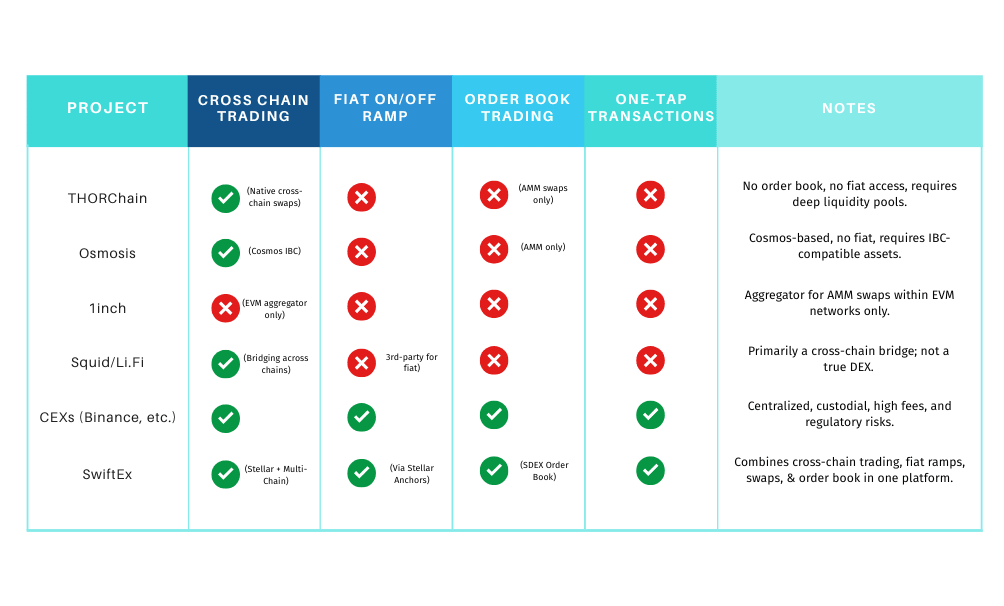
Professional traders require more than just trading tools — they need security, speed, and scalability. That’s where decentralized wallets for professionals like SwiftEx come in. Our platform offers multi-chain interoperability, allowing traders to manage Bitcoin, Ethereum, and hundreds of altcoins seamlessly.
Features such as:
- Private key control
- Integrated DEX trading
- On-chain analytics
- Low-fee spot trading
- Secure fiat/crypto conversions
make SwiftEx the ultimate hub for decentralized traders. With a sleek interface and institutional-grade protection, it bridges convenience with complete self-sovereignty.
Why Trade on Decentralized Exchanges
The simple answer is freedom. Decentralized trading platforms return the power to users, ensuring crypto asset ownership without compromise. When you trade on a DEX, your funds remain under your control, transactions are transparent, and no one can freeze or censor your trades.
For traders navigating the modern crypto landscape, understanding why trade on decentralized exchanges is crucial. The future belongs to those who control their keys not those who surrender them.
At SwiftEx, we make that transition effortless by combining on-chain trading, multi-chain access, and self-custody all in one powerful platform.
The Future of Decentralized Trading
As regulatory pressures increase and centralized exchanges face scrutiny, the shift to decentralized trading is accelerating. SwiftEx represents this new era one defined by trustless systems, permissionless trading, and secure crypto transactions that prioritize the trader above all.
The future of crypto will not be defined by who controls the platforms, but by who controls their keys. Decentralization ensures that power remains where it belongs in the hands of the people.
Conclusion
In a world where financial freedom is often limited by intermediaries and regulations, decentralization is not just an alternative it’s a revolution. It empowers traders to take charge of their destiny, preserve their privacy, and build wealth on their own terms.
At SwiftEx, we’re committed to leading this movement offering a non-custodial, decentralized, and multi-chain trading experience designed for those who value independence, transparency, and security above all else.
Follow us on