Trump Crypto Policies: What They Mean for DeFi Users in 2026
As the 2026 political cycle unfolds, Trump crypto policies are once again becoming a major talking point across financial markets. With decentralized finance (DeFi) now managing billions in on-chain liquidity, U.S. regulatory direction could significantly reshape how protocols, investors, and crypto startups operate.
So what would a renewed Trump administration mean for DeFi users?
Let’s break it down strategically
Trump’s Historical Stance on Cryptocurrency
During his presidency (2017–2021), Donald Trump publicly expressed skepticism toward cryptocurrencies, particularly Bitcoin. In 2019, he stated that he was “not a fan” of digital assets, citing concerns about volatility and illicit finance.
However, the political landscape has shifted dramatically since then:
- Crypto ownership in the U.S. has expanded significantly
- Institutional adoption has accelerated
- Spot Bitcoin ETFs have gained regulatory approval
- Blockchain innovation has become politically relevant
In recent campaign messaging, Trump has signaled a more pro-crypto tone, positioning himself as supportive of innovation and opposed to excessive regulatory crackdowns.
This shift makes Trump crypto policies in 2026 far more nuanced than in his first term.
Potential Trump Crypto Policies in 2026
While no formal legislative blueprint exists yet, policy direction under a Trump administration would likely focus on:
1. Reduced Regulatory Aggression
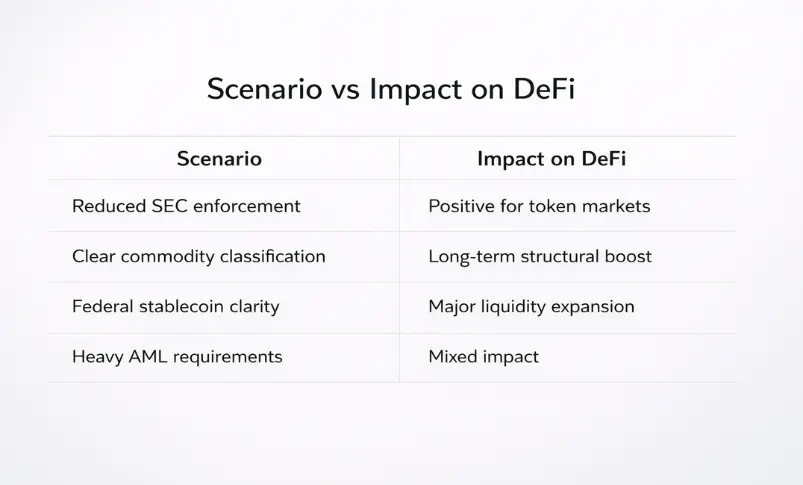
Under current enforcement-heavy approaches led by agencies like the U.S. Securities and Exchange Commission (SEC), many DeFi projects face legal uncertainty.
A Trump-led administration could:
- Replace SEC leadership
- Limit regulation-by-enforcement tactics
- Push for clearer crypto classification frameworks
This would directly impact DeFi token issuers and governance protocols.
2. Clearer Crypto Classification
One of the biggest issues in U.S. crypto markets is whether tokens are securities or commodities.
Regulatory coordination between the SEC and the Commodity Futures Trading Commission (CFTC) could be restructured to:
- Give CFTC more authority over crypto markets
- Provide commodity-style oversight for decentralized tokens
- Reduce uncertainty for DeFi governance tokens
For DeFi users, clarity = reduced delisting risk and exchange stability.
3. Stablecoin Policy Reform
Stablecoins are the backbone of DeFi liquidity.
If Trump crypto policies lean toward market-friendly frameworks, we could see:
- Federal stablecoin legislation
- Bank-issued stablecoin approvals
- Reduced risk of sudden compliance shutdowns
This would directly affect protocols using US dollar-pegged assets as collateral.
4. Support for U.S.-Based Crypto Innovation
Campaign rhetoric has included positioning the U.S. as a global crypto leader rather than pushing innovation offshore.
That could mean:
- Incentives for blockchain startups
- Reduced pressure on non-custodial protocols
- Strategic Bitcoin reserve discussions
For DeFi builders, this is critical.
What Trump Crypto Policies Mean for DeFi Users
Now let’s focus specifically on DeFi users in 2026.
🔹 1. Lower Regulatory Risk (Short Term)
If enforcement slows:
- Fewer lawsuits against major protocols
- Reduced fear-driven token selloffs
- Improved investor sentiment
DeFi TVL (Total Value Locked) could rise under favorable regulatory signals.
🔹 2. Increased Institutional Participation
Clearer rules often attract:
- Hedge funds
- Family offices
- Tokenized asset platforms
More institutional liquidity could:
- Lower spreads
- Improve yield stability
- Increase protocol sustainability
🔹 3. Potential Political Volatility
However, crypto is now deeply political.
A shift in administration could also:
- Trigger regulatory reversals after future elections
- Create short-term market volatility
- Increase partisan crypto narratives
DeFi users must factor in policy cycles as part of risk management.
Risks to Watch Under Trump Crypto Policies
Even under a pro-crypto stance, risks remain:
- Strong AML enforcement
- Pressure on privacy protocols
- Increased reporting requirements
- Geopolitical sanctions compliance
DeFi doesn’t exist outside the global financial system. Regulation will evolve — not disappear.
Final Thoughts: Should DeFi Users Be Optimistic?
The answer depends on implementation.
A second Trump administration would likely pursue:
- Regulatory clarity
- Reduced enforcement hostility
- Pro-market positioning
For DeFi users, that generally signals opportunity — but not deregulation.
Smart investors should:
- Diversify across jurisdictions
- Monitor legislative developments
- Track SEC and CFTC leadership changes
- Stay compliant with evolving reporting rules
Follow us on