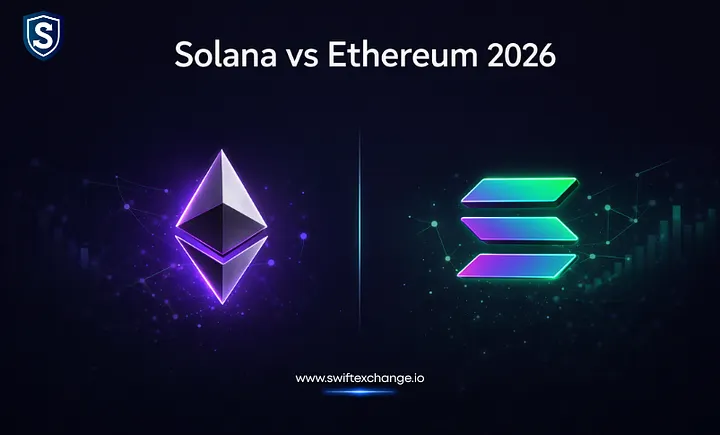
Solana vs Ethereum 2026: Which Blockchain Dominates the Future of Crypto?
The blockchain industry continues to evolve rapidly, and two networks remain at the center of the conversation: Solana and Ethereum. As we move deeper into 2026, the debate around Solana vs Ethereum 2026 has intensified among investors, developers, and institutions.
Both blockchains power massive ecosystems of decentralized applications, decentralized finance (DeFi), NFTs, and Web3 innovation. However, they approach scalability, network architecture, and adoption in very different ways.
While Ethereum remains the most established smart contract platform, Solana has rapidly gained traction due to its high throughput and low transaction fees. With upcoming upgrades, growing institutional interest, and evolving user behavior, the question remains:
Which blockchain will dominate the future of crypto in 2026?
Understanding Solana and Ethereum
Before comparing the two networks, it is important to understand what makes them unique.
Ethereum: The Foundation of Smart Contracts
Launched in 2015, Ethereum introduced the concept of programmable blockchain through smart contracts. It quickly became the backbone of decentralized finance and Web3 development.
Key characteristics of Ethereum include:
- Highly decentralized network
- Large developer ecosystem
- Strong institutional adoption
- A mature DeFi infrastructure
Ethereum’s roadmap focuses on scalability through Layer 2 networks such as Arbitrum, Optimism, and Base, which help process transactions off-chain while maintaining Ethereum’s security.
Solana: The High-Speed Challenger
Solana was launched in 2020 with a very different philosophy. Instead of relying heavily on Layer 2 scaling solutions, Solana focuses on maximizing performance directly on the base layer.
The network uses Proof of History (PoH) combined with Proof of Stake to achieve extremely fast transaction processing.
Key advantages of Solana include:
- Very high transaction throughput
- Extremely low fees
- Fast transaction finality
- Strong activity in consumer apps
Because of these advantages, Solana has become popular for applications involving gaming, NFTs, and memecoin trading.
Solana vs Ethereum 2026: Key Differences
To determine which chain dominates in 2026, several critical factors must be analyzed.
1. Network Speed and Scalability
One of the biggest differences in the Solana vs Ethereum 2026 debate is performance.
Solana was designed for speed. The network can process thousands of transactions per second with near-instant confirmation.
Ethereum, on the other hand, prioritizes decentralization and security. While its base layer processes fewer transactions, Layer 2 solutions dramatically increase scalability.
In practice:
- Solana: High throughput on Layer 1
- Ethereum: Scales through Layer 2 ecosystems
This modular architecture allows Ethereum to scale without compromising decentralization, but it also fragments liquidity across multiple networks.
2. Transaction Fees
Transaction cost is another major factor influencing blockchain adoption.
Solana transactions are known for their extremely low fees, often costing fractions of a cent.
Ethereum fees historically have been higher, especially during periods of network congestion. However, Layer 2 networks significantly reduce these costs.
For users:
- Solana offers cheaper direct transactions
- Ethereum provides scalability through L2 solutions
3. Developer Ecosystem
Developer activity plays a major role in determining which blockchain dominates long term.
Ethereum still maintains the largest developer community in Web3. Many of the biggest DeFi protocols and infrastructure tools were originally built on Ethereum.
However, Solana’s developer ecosystem has grown rapidly in recent years. Its high performance and simplified user experience attract builders focused on consumer applications.
The difference in 2026 looks like this:
Ethereum leads in:
- DeFi infrastructure
- enterprise adoption
- institutional integrations
Solana leads in:
- gaming applications
- retail-focused app
- high-frequency trading environments
4. Institutional Adoption
Institutional interest is another key metric shaping the Solana vs Ethereum 2026 narrative.
Ethereum remains the preferred network for many institutional players due to its security, decentralization, and liquidity depth.
However, Solana has started attracting institutional attention as well, particularly with growing discussions around crypto ETFs and increasing on-chain revenue growth.
This shift indicates that both ecosystems are becoming increasingly important for large-scale financial participation.
5. Ecosystem Growth and Use Cases
The two networks also differ in how their ecosystems evolve.
Ethereum focuses heavily on:
- decentralized finance (DeFi)
- tokenized real-world assets
- enterprise blockchain solutions
Solana, meanwhile, has become a hub for:
- high-speed trading platforms
- gaming and NFTs
- retail-driven crypto activit
This difference reflects broader user behavior patterns within the blockchain industry.
Upcoming Upgrades That Could Change the Race
Both networks have major technological upgrades planned that could reshape their competitive positioning.
Solana is preparing for Firedancer, a new validator client expected to significantly improve network performance and reliability.
Ethereum continues advancing its modular roadmap with upgrades such as Fusaka, focusing on improved scalability and efficiency for Layer 2 networks.
These upgrades may significantly influence how the two blockchains compete throughout the rest of the decade.
Which Blockchain Is Winning in 2026?
Determining a single winner in the Solana vs Ethereum 2026 debate is not straightforward.
Instead, the two networks appear to be specializing in different areas of the blockchain ecosystem.
Ethereum continues to dominate:
- institutional finance
- long-term infrastructure
- decentralized security
Solana excels in:
- speed and performance
- consumer applications
- high-frequency blockchain activity
Rather than replacing Ethereum, Solana is carving out its own niche in the Web3 landscape.
The Future of Solana vs Ethereum
Looking ahead, it is likely that both networks will coexist rather than compete for total dominance.
Ethereum’s ecosystem of Layer 2 solutions ensures continued scalability while maintaining strong decentralization. Meanwhile, Solana’s high-performance design makes it ideal for applications requiring speed and low costs.
As blockchain adoption continues to expand globally, the industry may evolve into a multi-chain ecosystem, where different networks specialize in different use cases.
In that future, both Solana and Ethereum could play critical roles in shaping the next generation of decentralized technology.
Final Thoughts
The Solana vs Ethereum 2026 debate highlights how quickly the blockchain industry is evolving. Ethereum remains the foundation of decentralized finance and institutional blockchain adoption, while Solana is pushing the boundaries of speed and consumer-focused applications.
Ultimately, the question may not be which blockchain wins entirely, but which one leads in specific sectors of the Web3 economy.
As innovation accelerates, both Solana and Ethereum are likely to remain central players in the future of cryptocurrency.
Follow us on