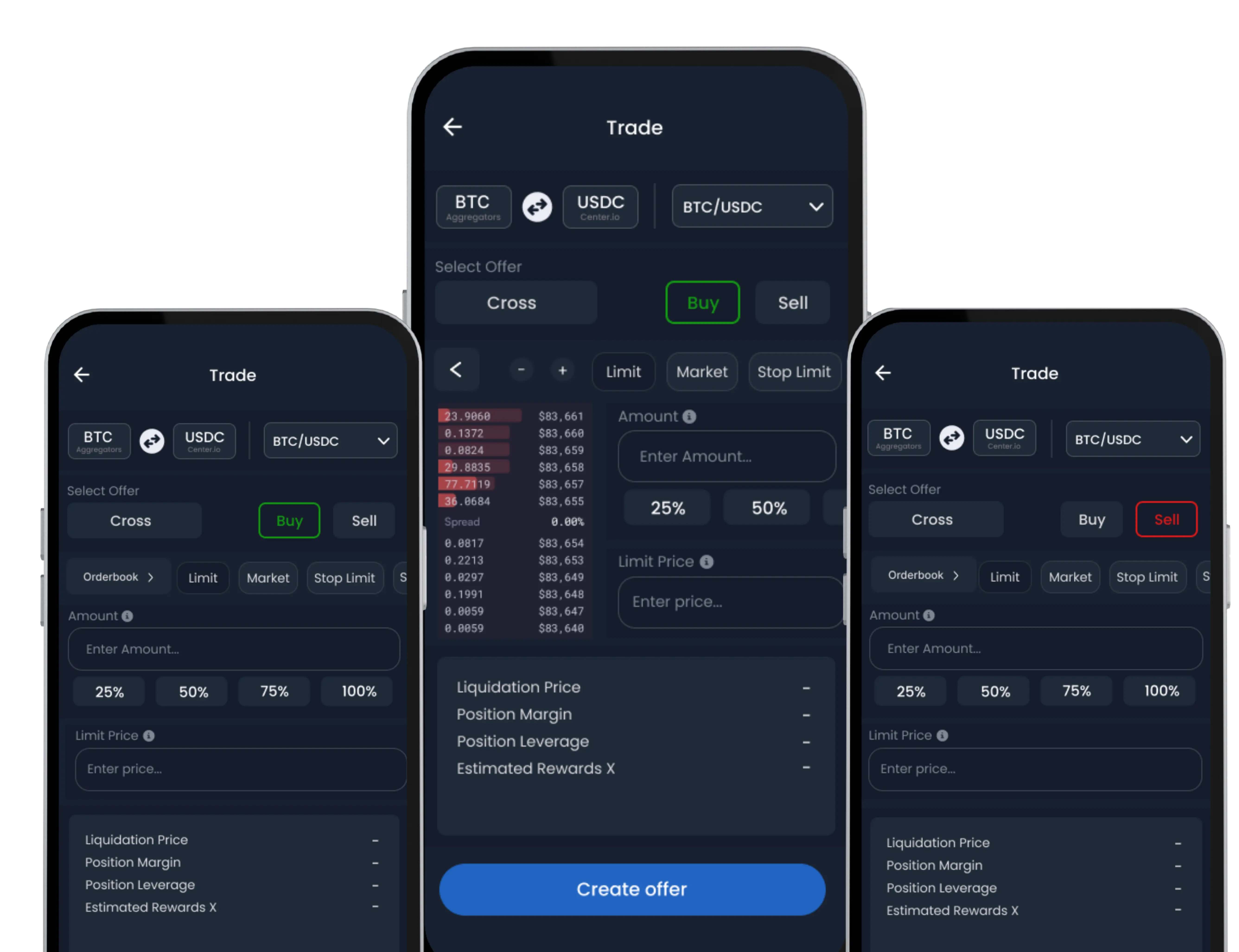
Liquidity Is Fragmented And That’s a $100B Problem in DeFi
And Why Intent-Based Trading Will Replace Order Books
Introduction: DeFi’s Efficiency Problem No One Talks About
DeFi was built on the promise of open and efficient markets. But beneath the surface, a structural inefficiency continues to grow fragmented liquidity.
Today, capital is spread across chains, protocols, and pools.
Execution depends not on global efficiency, but on where liquidity happens to exist.
The result is a hidden cost:
- Worse pricing
- Higher slippage
- Idle capital
- Complex user flows
This isn’t a minor inefficiency. It’s a $100B+ problem limiting DeFi’s true potential.

What Is Fragmented Liquidity in DeFi?
Fragmented liquidity in DeFi refers to capital being distributed across:
- Multiple blockchains (Ethereum, Arbitrum, Solana, etc.)
- Separate DEXs and protocols
- Independent liquidity pools
Instead of a unified market, DeFi operates as a network of isolated liquidity silos.
This creates:
- Inconsistent pricing
- Inefficient capital allocation
- Reduced execution quality
In traditional finance, liquidity aggregates into deep markets.
In DeFi, it disperses.
Why Liquidity Fragmentation Exists
1. The Multi-Chain Expansion
Each new chain or Layer 2 introduces:
- Its own liquidity
- Its own users
- Its own ecosystem
Rather than scaling liquidity, DeFi splits it.
2. Protocol Duplication
Major protocols deploy across chains, but liquidity does not merge.
Each deployment becomes:
- A separate pool
- A separate market
- A separate pricing layer
3. Lack of Native Interoperability
Blockchains are not designed to communicate seamlessly.
Bridges attempt to connect them, but:
- Add fees
- Introduce latency
- Increase risk
They move assets but do not unify liquidity.
The Hidden Cost of Fragmented Liquidity
Capital Inefficiency
- Billions locked in isolated pools
- Liquidity duplicated across chains
- Idle capital earning suboptimal yield
Slippage and Poor Execution
- Smaller pools lead to higher price impact
- Trades execute at worse rates
- Large trades often fail
Arbitrage as a Structural Tax
Price gaps across chains are exploited by arbitrageurs.
This creates:
- Continuous value extraction
- A hidden cost passed to users
Bridging Overhead
Cross-chain activity requires:
- Multiple transactions
- Additional fees
- Time delays
This reduces net returns and increases friction.
How Users Experience This Problem
Most users do not think in terms of “liquidity fragmentation,” but they experience it directly:
- Unexpected slippage
- Failed transactions
- Multiple gas tokens required
- Complex, multi-step workflows
The system is fragmented. The user experience reflects it.
Why Bridges and Aggregators Are Not Enough
Bridges and DEX aggregators improve routing but they do not solve the root issue.
- Liquidity remains siloed
- Pricing remains inconsistent
- Capital remains inefficient
These solutions operate on top of fragmentation, not beneath it.
Liquidity Aggregation at the Protocol Level
The real shift is not better routing it is restructuring where liquidity lives.
Liquidity aggregation at the protocol level introduces a different model:
Instead of:
Chain → Protocol → Isolated Liquidity Pool
The system evolves toward:
Protocol → Unified Liquidity Layer → Multi-Chain Access
What This Enables
Unified Capital Access
Liquidity becomes globally accessible rather than chain-specific.
Higher Capital Efficiency
The same capital serves multiple markets instead of being duplicated.
Consistent Pricing
Reduced fragmentation leads to tighter spreads and better execution.
Reduced Bridging Dependency
Users no longer need to manually move assets across chains.
This is not a UX improvement. It is an infrastructure-level change.
The Limits of Current Trading Models
DeFi trading today relies on:
- Automated Market Makers (AMMs)
- Order books in select protocols
Both models depend on:
- Local liquidity
- Chain-specific execution
This creates a fundamental limitation:
Execution quality is constrained by liquidity location
What Comes Next: Intent-Based Trading
Intent-based trading introduces a new paradigm.
Instead of defining execution steps, users define outcomes.
Example:
“Swap X for Y at the best possible price”
How It Works
- Users submit an intent
- Solvers compete to fulfill it
- Liquidity is sourced across chains and venues
- The best execution path is selected automatically
The Shift in Model
Traditional model:
Locate liquidity → Execute trade
Intent-based model:
Define outcome → System finds optimal execution
Why Intent-Based Trading Will Replace Order Books
Order books assume:
- A single venue
- Local liquidity
- Manual interaction
These assumptions break in a fragmented, multi-chain environment.
Intent-based systems:
- Aggregate liquidity globally
- Abstract execution complexity
- Optimize across all available sources
As a result, for most users:
- Order books become unnecessary
- Manual routing becomes obsolete
Execution becomes outcome-driven, not venue-driven.
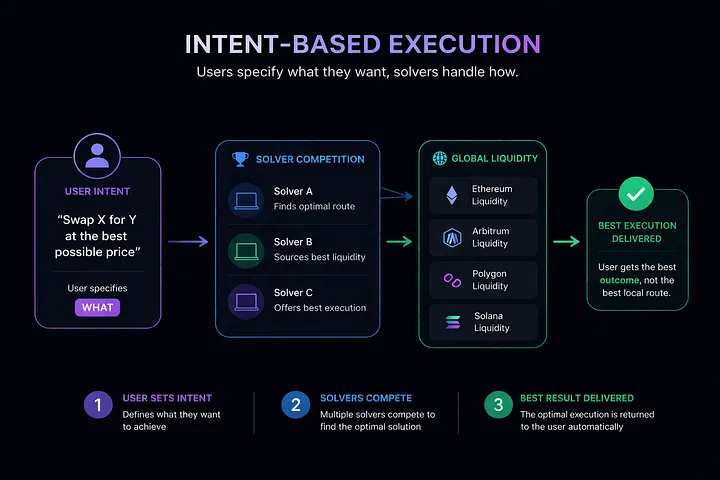
Solving Fragmentation vs. Abstracting It
Intent-based trading does not eliminate fragmentation at the base layer.
Instead, it:
- Routes across fragmented liquidity
- Hides complexity from the user
- Delivers optimal outcomes regardless of location
At the same time, protocol-level aggregation works to:
- Reduce fragmentation structurally
- Improve capital efficiency
Together, they form a complete solution.
The Emerging DeFi Stack
The next phase of DeFi will be defined by three layers:
1. Protocol-Level Liquidity Aggregation
Unifies capital across environments.
2. Intent-Based Execution
Optimizes how trades are executed.
3. Chain Abstraction
Removes the need for users to interact with chains directly.
This combination creates:
- Seamless execution
- Efficient capital usage
- Simplified user experience
The End State: A Unified Liquidity Layer
In the long term, users will not:
- Choose chains
- Manage bridges
- Think about liquidity sources
They will simply:
- Define an outcome
- Receive the best possible execution
Liquidity will behave as a single global layer, even if infrastructure remains modular.
Conclusion: From Fragmentation to Abstraction
Fragmented liquidity is not just a technical inefficiency it is the defining limitation of current DeFi architecture.
Solving it requires:
- Structural changes to liquidity distribution
- New execution models
- Abstraction of underlying complexity
The shift is already underway.
The systems that succeed will not compete on:
- Number of chains
- Number of pools
They will compete on:
- Execution quality
- Capital efficiency
- User experience
Ultimately, users do not care about infrastructure.
They care about outcomes.
And the platforms that deliver those outcomes efficiently and invisibly will define the next phase of decentralized finance.
Read More — Inside 1inch Resolver Pattern: Architecture & Case Study
Follow us on