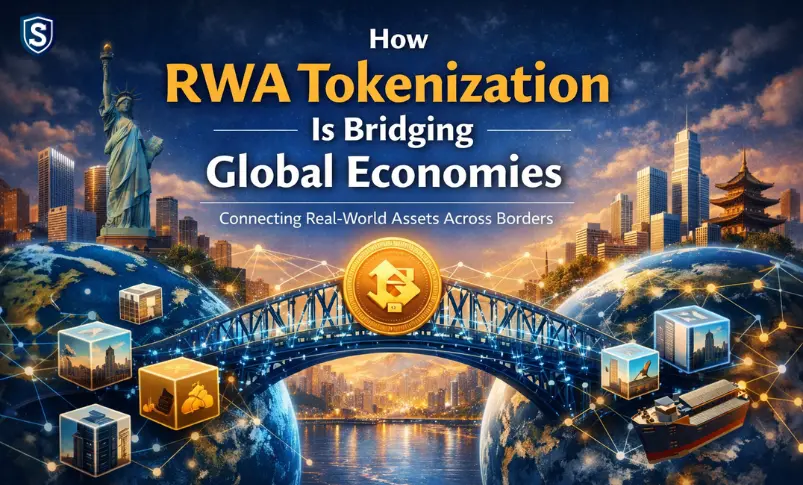
How RWA Tokenization Is Bridging Global Economies
Global finance has long been limited by borders, intermediaries, and restricted access to capital. Today, RWA tokenization is emerging as a powerful solution connecting traditional assets with blockchain technology and unlocking participation across global markets.
By bringing real-world assets (RWAs) on-chain, tokenization is transforming how value moves, who can invest, and how economies interact in a digital-first world.
What Is RWA Tokenization?
RWA tokenization refers to the process of converting real-world assets such as real estate, bonds, commodities, and invoices into blockchain-based tokens.
These tokens represent ownership or rights to the underlying asset and can be:
- Traded digitally
- Fractionalized for broader access
- Settled faster with lower costs
- Managed transparently on-chain
In essence, tokenization brings physical and financial assets into decentralized digital ecosystems.
Why RWA Tokenization Matters for Global Economies
Traditional asset markets are often:
- Illiquid
- Geographically restricted
- Accessible only to institutions
- Burdened by high settlement costs
Tokenized real-world assets remove these barriers by enabling borderless, 24/7 access to value.
Key Economic Impacts
- Democratized investment opportunities
- Improved global liquidity
- Faster cross-border capital flows
- Reduced reliance on intermediaries
This is how RWA tokenization begins to bridge global economies.
From Local Assets to Global Markets
One of the most powerful advantages of tokenized real-world assets is global reach.
For example:
- A real estate asset in one country can be fractionally owned by investors worldwide
- Government or corporate bonds can trade on-chain with near-instant settlement
- Commodities can be accessed digitally without physical transfer
This shift enables global participation in traditionally closed markets.
RWA Tokenization and Blockchain Infrastructure
Blockchain plays a critical role in making RWA tokenization possible:
- Transparency through immutable records
- Security via cryptographic ownership
- Efficiency with automated settlement
- Interoperability across chains
As multi-chain ecosystems grow, tokenized assets must move seamlessly across networks making interoperability a key requirement.
Institutional Adoption of RWA Tokenization
Institutions are increasingly exploring RWA tokenization to:
- Reduce operational costs
- Improve capital efficiency
- Expand market access
- Enable real-time settlement
From asset managers to fintech firms, tokenized assets in finance are shifting from experimentation to real-world deployment.
The Role of DeFi in Tokenized Assets
Decentralized finance (DeFi) adds another layer of utility to RWAs:
- Tokenized assets can be used as collateral
- Liquidity pools enable secondary markets
- Smart contracts automate yield distribution
This convergence of RWA crypto and DeFi creates a more efficient, programmable financial system.
How SwiftEx Fits into the RWA Tokenization Future
SwiftEx is built for the next generation of decentralized finance and global asset access.
As a non-custodial, multi-chain crypto wallet and DEX, SwiftEx empowers users with:
- Full ownership of assets (no custodians)
- Secure, low-fee spot trading
- Seamless fiat-to-crypto and crypto-to-fiat conversions
- Cross-chain swapping and bridging
- Global, on-the-go crypto access
As RWA tokenization expands across multiple blockchains, platforms like SwiftEx provide the infrastructure users need to manage, trade, and move tokenized assets securely and efficiently without centralized control.
Challenges Facing RWA Tokenization
Despite its promise, RWA tokenization faces challenges:
- Regulatory alignment across jurisdictions
- Asset verification and legal enforceability
- Standardization of token frameworks
- Cross-chain compatibility
Solving these issues is critical for large-scale global adoption.
The Future of RWA Tokenization
The future points toward:
- Greater institutional participation
- Multi-chain tokenized asset ecosystems
- Improved regulatory clarity
- Integration with non-custodial DeFi platforms
As these pieces come together, RWA tokenization will become a foundational layer of global finance.
Final Thoughts
RWA tokenization is more than a technical innovation it’s a structural shift in how global economies interact. By turning real-world assets into programmable, borderless digital instruments, tokenization is expanding access, improving liquidity, and redefining ownership.
With its non-custodial, multi-chain architecture, SwiftEx is positioned to support this evolution empowering users worldwide to participate in the future of tokenized global finance.
Follow us on