Inside 1inch Resolver Pattern: Architecture & Case Study
Introduction
As decentralized finance evolves, efficient trade execution has become one of the most critical challenges. Protocols are no longer competing just on liquidity they’re competing on how well they execute user intent.
One of the most innovative approaches in this space comes from 1inch Network through its Resolver Pattern.
In this blog, we break down the architecture, explain how it works, and analyze a real-world case study of how the 1inch Resolver Pattern improves DeFi execution.
What is the 1inch Resolver Pattern?
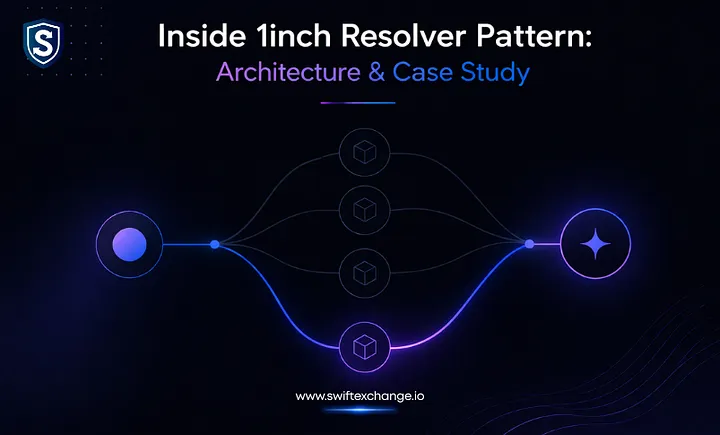
The 1inch Resolver Pattern is an execution mechanism where third-party actors called resolvers compete to fulfill user trade intents in the most efficient way possible.
Instead of relying on traditional AMM swaps or simple routing, this model introduces:
- Off-chain competition
- On-chain settlement
- Optimized execution strategies
Why this matters
Users don’t just want swaps they want:
- Best price
- Minimal slippage
- MEV protection
- Faster execution
The resolver pattern is designed to deliver all of this.
Core Architecture of the Resolver Pattern
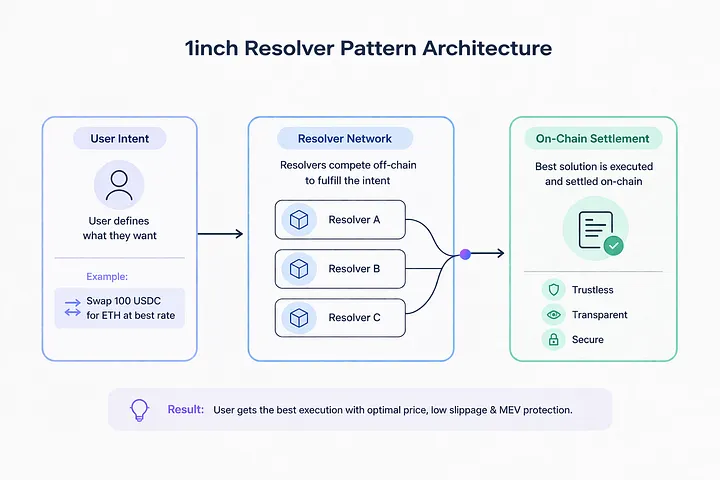
The architecture can be broken down into three main components:
1. User Intent Layer
Users define what they want, not how to execute it.
Example:
“Swap 100 USDC for ETH at the best possible rate”
This abstraction is key to intent-based trading.
2. Resolver Network
Resolvers are independent actors who:
- Monitor user intents
- Compete to fulfill them
- Use advanced strategies (arbitrage, private liquidity, batching)
They essentially act as execution specialists.
3. Smart Contract Settlement Layer
Once a resolver finds the optimal execution path:
- The transaction is submitted on-chain
- Smart contracts verify conditions
- Settlement is finalized trustlessly
This ensures:
- Security
- Transparency
- Non-custodial execution
How the 1inch Resolver Pattern Works (Step-by-Step)
Step 1: Intent Creation
The user submits a trade intent via the interface or API.
Step 2: Off-Chain Competition
Resolvers analyze the intent and compete to offer the best execution.
Step 3: Execution Strategy
Resolvers may:
- Aggregate liquidity across DEXs
- Use private liquidity sources
- Avoid MEV through private relays
Step 4: On-Chain Settlement
The best solution is executed and verified via smart contracts.
Case Study: Swap Optimization Using Resolver Pattern
Let’s break down a simplified real-world scenario:
Scenario
A user wants to swap:
- 50,000 USDC → ETH
Traditional DEX Aggregator Approach
- Routes through multiple pools
- Suffers slippage
- Exposed to MEV bots
With 1inch Resolver Pattern
Resolvers can:
- Split orders intelligently
- Use off-chain liquidity
- Execute via private channels
Result
- Better price execution
- Lower slippage
- Reduced MEV risk
- Faster settlement
Key Advantages of the Resolver Pattern
1. Better Price Discovery
Resolvers compete, leading to optimal pricing.
2. MEV Resistance
Private execution paths reduce front-running and sandwich attacks.
3. Capital Efficiency
Resolvers can tap into fragmented liquidity across ecosystems.
4. Intent-Based UX
Users focus on outcomes, not execution complexity.
Resolver Pattern vs Traditional DeFi Execution
Why This Matters for the Future of DeFi
The resolver pattern represents a shift from:
Transaction-based systems → Intent-based systems
This is the same direction the broader DeFi ecosystem is heading toward:
- Intent-centric architectures
- Solver/resolver networks
- Execution abstraction layers
Protocols that adopt this model will likely dominate the next phase of DeFi infrastructure.
How This Connects to Execution Layers like SwiftEx
If you’re building in DeFi, the takeaway is clear:
Execution is becoming a separate, specialized layer.
The 1inch resolver model proves that:
- Liquidity alone isn’t enough
- Execution quality is the real differentiator
This is exactly where next-gen platforms (like SwiftEx) can innovate:
- Unified execution layers
- Cross-chain intent fulfillment
- Aggregated resolver networks
Final Thoughts
The 1inch Resolver Pattern is more than just a technical upgrade it’s a fundamental shift in how decentralized trading works.
By combining:
- Off-chain competition
- On-chain trust
- Intent-based design
It delivers a significantly better trading experience.
As DeFi matures, resolver-based architectures will likely become the standard for high-performance execution.
FAQs
What is the 1inch Resolver Pattern?
A system where third-party resolvers compete to execute trades efficiently based on user intent.
How does 1inch improve trade execution?
By enabling off-chain competition and optimized routing before on-chain settlement.
What are resolvers in DeFi?
Independent actors that execute trades on behalf of users using advanced strategies.
Is the resolver pattern safe?
Yes, because final settlement happens via audited smart contracts.
Follow us on