DeFi Protocols on Stellar: DeFindex and Blend Explained
1. Introduction: Why Stellar Needed a Smart Contract Layer
For years, decentralized finance centered almost exclusively on the Ethereum Virtual Machine and high-throughput monolithic networks like Solana. The Stellar network was historically recognized for global payments, fiat anchors, and its native order book, the Stellar Decentralized Exchange (SDEX). While SDEX handled basic limit orders efficiently, it lacked the Turing-complete programmability required to build modern money markets, automated yield strategies, or dynamic liquidity vaults.
The activation of Soroban, Stellar’s Rust-based WebAssembly smart contract platform launched with Protocol 20, opened a new architectural layer for the network. By combining compile-time Rust memory safety and typically fast ledger settlement, Soroban established an execution environment designed for predictable, low-cost decentralized finance. Transaction costs depend on resource consumption , CPU instructions, memory, storage access, and state rent , rather than a fixed fee, and are generally a fraction of a cent for standard contract interactions.
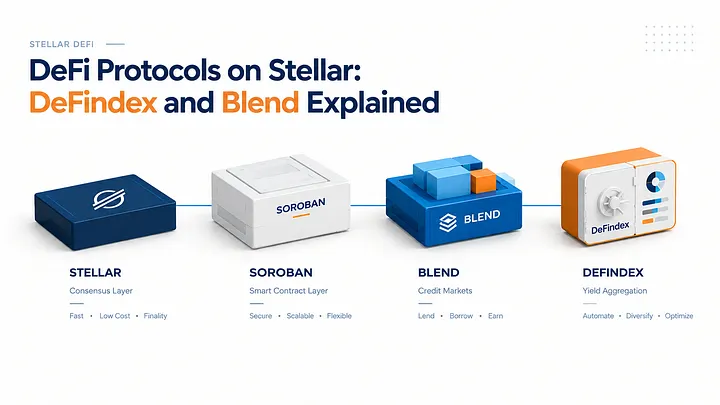
Within this environment, decentralized finance organizes into distinct infrastructure tiers. At the base layer, the Stellar Consensus Protocol (SCP) , an implementation of Federated Byzantine Agreement , provides fast finality without mining or energy-intensive computation. Directly above consensus, Soroban executes smart contracts with explicit state management and pre-declared storage footprints. Building on this foundation, two native protocols handle the financial logic: Blend Protocol for credit markets, and DeFindex for yield aggregation and automated portfolio management.
Understanding how each of these protocols operates, and how they interact, matters for any developer or investor building or allocating capital in the Stellar DeFi ecosystem.
2. Blend Protocol: Non-Custodial Money Markets on Soroban
Blend (Blend Capital) is a decentralized, non-custodial liquidity protocol built natively on Soroban. It enables market participants, institutions, and autonomous organizations to supply assets, borrow capital, and create specialized credit pools without relying on centralized intermediaries.
Isolated Pool Architecture
Unlike legacy lending protocols that pool all platform assets into a single shared risk pool, Blend utilizes isolated lending markets. In a shared pool system, such as early iterations of Compound or Aave v2, a single compromised collateral asset or manipulated oracle feed can drain the liquidity reserves of the entire protocol.
Blend isolates each lending pool with its own specific configuration:
- Collateral Factors and Loan-To-Value (LTV): Each pool defines conservative borrowing limits tailored to the volatility of the underlying tokens.
- Oracle Feeds: Pool creators specify dedicated price oracles, such as SEP-40 compliant data feeds, on an individual pool basis rather than sharing a single protocol-wide oracle.
- Liability Caps: Strict borrowing limits prevent excessive concentration in illiquid or high-risk assets.
If an asset inside an isolated pool experiences an unexpected exploit or a severe price divergence, the insolvency risk is quarantined within that single pool. Other lending markets across the platform continue operating without contagion. This design is a meaningful departure from the monolithic pool architecture that made Compound and early Aave vulnerable to single-asset contagion events.
The Backstop Module: Bad-Debt Protection
A critical structural component within Blend is the Backstop Module , a dedicated first-loss capital layer that sits beneath each pool’s primary reserves. Decentralized lending protocols can accumulate bad debt when sudden market downturns outpace liquidators, and the Backstop Module is designed to absorb that deficit before it reaches primary suppliers.
To deploy and activate a new lending pool on Blend, depositors must supply capital to the pool’s Backstop Module. The backstop accepts BLND:USDC 80:20 liquidity pool shares as collateral. This requirement prevents spam pool creation while ensuring every active market has real capital backing it.
This mechanism produces two direct effects:
- Bad Debt Absorption: When a borrower position becomes insolvent and cannot be fully liquidated, the Backstop Module covers the shortfall, shielding primary suppliers from direct loss.
- Economic Alignment: Backstop depositors earn a portion of all borrower interest (the Backstop Take Rate) along with BLND token distributions, directly compensating them for absorbing tail risk.
The Backstop Module represents a considered bad-debt protection design for the Soroban DeFi context. It avoids the liquidity-draining mechanics of safety modules that rely on governance-voted slashing, and instead hard-wires first-loss capital into pool activation itself. That said, backstop capital is bounded , users should understand it as a risk-mitigation layer rather than an unconditional guarantee.
Reactive Interest Rate Model
Blend replaces manual governance votes and delayed parameter adjustments with a continuous, programmatic interest rate model. The protocol tracks the utilization ratio for each asset, defined as total borrowed capital divided by total supplied capital.
When asset utilization stays below the target threshold, borrow rates remain low to stimulate loan demand. If utilization surges toward 100%, the interest rate curve steepens sharply. This response encourages borrowers to repay outstanding debt while simultaneously attracting fresh supplier capital, preserving liquid reserves for depositors requesting withdrawals.
Notably, this model requires no governance intervention to function. Interest rates react to market conditions in real time, which matters on Soroban where governance proposals and parameter votes introduce latency that fast-moving market conditions cannot tolerate.
Dutch Auction Liquidation Mechanism
Rather than relying on fixed-discount liquidations that trigger high-fee competition, Blend uses descending Dutch auctions for undercollateralized positions.
When a borrower’s account becomes delinquent , meaning their outstanding liabilities exceed their borrow limit , any user can initiate an on-chain liquidation auction. The initiator specifies what percentage of the user’s collateral and liabilities should be included, with the constraint that the auction parameters must target a post-liquidation account health within an acceptable range (typically between 1.03 and 1.15 above the borrow limit).
The auction runs over 400 blocks. During the first 200 blocks, the percentage of collateral transferred to the liquidator increases by 0.05% per block, making the deal progressively more attractive. During the second 200 blocks, the percentage of debt the liquidator must repay decreases by 0.05% per block. The first liquidator willing to accept the current clearing price settles the position. This mechanism protects borrowers from punitive rates during orderly conditions, while providing growing economic incentive during volatility.
By using market-driven auctions, the protocol also reduces its reliance on price oracles for the liquidation process itself, mitigating risks associated with oracle manipulation at the point of settlement.
3. DeFindex: Modular Yield Infrastructure and Vaults
While Blend provides the core lending engine, market participants and application developers need tools to allocate capital across different strategies automatically. Built by PaltaLabs, DeFindex is an asset-management and yield-infrastructure protocol engineered natively for Soroban.
DeFindex provides vault and yield-routing infrastructure on Stellar, standardizing how capital moves into underlying smart contract primitives like Blend, Soroswap, and Phoenix Finance.
Vault and Strategy Modularity
DeFindex decouples user balance accounting from execution logic using three distinct contract layers:
- Factory Contract: Deploys new vault instances and registers verified asset allocation rules. Anyone can deploy a vault through the factory, subject to configuring a valid strategy set.
- Vault Contracts: Hold user deposits, issue yield-bearing vault share tokens (architecturally similar to the EVM ERC-4626 standard), and track proportional asset ownership across all depositors.
- Strategy Contracts: Contain the execution logic that deploys assets into external protocols, harvests yield, and processes withdrawals back to vault reserves.
Developers build custom yield connectors using the open-source Rust library defindex-strategy-core. Every strategy implements the standardized DeFindexStrategyTrait, defining core functions for deposit, withdrawal, balance verification, and yield harvesting. This means any Soroban-compatible protocol can be integrated as a strategy target without modifying the core vault contract.
A single DeFindex vault can hold a multi-asset basket , for instance 50% USDC, 30% XLM, and 20% EURC , deploying each portion into separate yield-generating contracts without changing the user-facing interface.
Automated Portfolio Rebalancing
Market price movements cause asset allocations to drift away from target ratios over time. DeFindex incorporates programmatic rebalancing mechanisms. Authorized Rebalancers (also referred to as Rebalance Managers) monitor vault weights against predefined boundaries. When drift exceeds allowed thresholds, the vault executes swaps across Soroban decentralized exchanges, such as Soroswap or Phoenix Finance, to restore target allocation.
This is a meaningful improvement over passive deposit protocols that force users to manually reallocate as market conditions shift. For stablecoin-heavy vaults, drift tends to be small, but for multi-asset strategies holding XLM alongside dollar-denominated assets, periodic rebalancing is required to prevent significant unintended concentration.
Role-Based Security Architecture
DeFindex enforces strict role separation at the smart contract level to safeguard user assets across complex multi-contract execution flows. The following roles are defined in the vault contract constructor (verified from the DeFindex vault contract source, audited by OtterSec):
- Manager (RolesDataKey::Manager): Configures initial deposit parameters, fee splits, and strategy allocations. This role carries the highest privilege and should be held by a multi-sig or governance-controlled address.
- Emergency Manager (RolesDataKey::EmergencyManager): Authorized to execute emergency rescue operations , pulling capital from a strategy back into the core vault , if an underlying protocol encounters a critical failure state.
- Vault Fee Receiver (RolesDataKey::VaultFeeReceiver): The address that receives vault-level fee distributions.
- Rebalance Manager (RolesDataKey::RebalanceManager): Responsible for monitoring vault weights and triggering rebalancing operations to restore target allocations.
The separation between the Manager and Emergency Manager roles is important. It allows the protocol to respond to critical failures without requiring the primary Manager to act, and without exposing the full configuration authority to the emergency responder.
4. How DeFindex and Blend Work Together
The relationship between Blend and DeFindex is a notable complementary architectural pairing in the current Stellar DeFi stack. Blend provides the credit market infrastructure. DeFindex provides the orchestration layer above it.
A typical Blend-backed strategy in a DeFindex vault can work as follows:
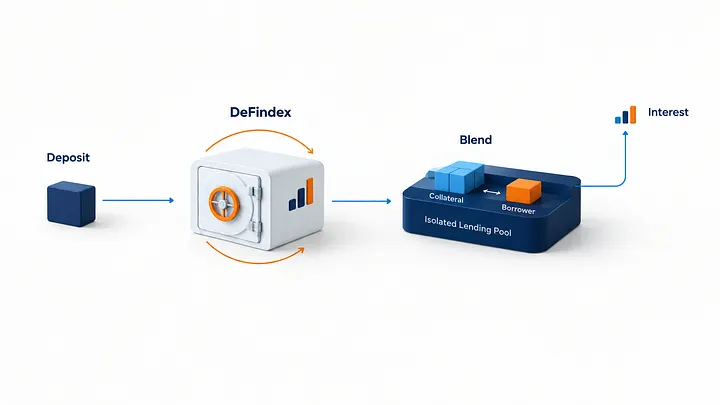
- A user deposits assets (for example, USDC) into a DeFindex vault.
- The vault mints proportional share tokens to the user’s self-custodial wallet address.
- The vault’s active Blend Strategy contract calls Blend’s supply function, depositing the USDC into the appropriate isolated lending pool.
- As Blend borrowers draw from the pool and pay interest, the underlying USDC balance in the pool grows.
- When the user withdraws from the DeFindex vault, the strategy contract calls Blend’s withdraw function, returning the principal plus accrued interest to the vault, which then burns the user’s share tokens at the appreciated rate.
This layered model separates concerns cleanly. Blend handles credit risk, interest rate mechanics, liquidations, and bad debt. DeFindex handles vault accounting, strategy routing, rebalancing triggers, and the user-facing share token standard. Neither protocol needs to know the internal implementation details of the other.
Beans App , a non-custodial wallet focused on international remittances , integrated DeFindex vaults to offer stablecoin savings features without building in-house smart contract infrastructure. According to DeFindex’s published case study, this integration drove $610,000 in stablecoin deposits within the first 90 days of launch. This demonstrates that the DeFindex and Blend pairing can serve as a reusable building block for application-level integrations, not just protocol-to-protocol connections.
5. Soroban’s Constraint Model: Ledger Footprints and State Management
Any developer building on top of DeFindex and Blend on Soroban must understand two architectural constraints that Soroban handles differently from Ethereum or Solana.
Explicit Ledger Footprints
Soroban requires every transaction to pre-declare its complete ledger footprint , all read-only and read-write storage keys , before submission to the network. The Soroban host does not allow a transaction to access any storage entry that was not declared upfront. If a nested contract call attempts to read an undeclared key, the host halts execution and reverts the entire transaction.
This matters for multi-protocol interactions because a single transaction flowing through a DeFindex vault into a Blend pool touches dozens of independent storage keys across multiple contracts. Application developers resolve this by using the Stellar RPC simulation endpoint, which dry-runs the full execution path and outputs the complete footprint before the transaction is signed and broadcast.
State Rent, TTL, and Protocol 23 Automatic Restoration
Soroban manages state sustainability through Time-To-Live (TTL) counters on storage entries, measured in ledger sequence numbers. If a storage entry’s TTL reaches zero, the entry transitions to an archived state and becomes inaccessible to smart contracts until it is restored.
Starting with Protocol 23, the Stellar network introduced automatic state restoration for eligible archived entries. When an InvokeHostFunctionOp transaction is simulated via the Stellar RPC, the simulation detects any archived entries required for execution and populates the necessary restoration data. When the transaction is executed on-chain, the network automatically restores those entries before the contract logic runs. Only PERSISTENT and INSTANCE storage entries are eligible for automatic restoration; TEMPORARY entries, once expired, cannot be recovered.
This significantly simplifies the developer experience compared to pre-Protocol 23, where manual RestoreFootprintOp operations had to be constructed and submitted separately. However, automatic restoration is not free , restored entries incur additional ledger read, write, and rent fees. For active protocols with real user deposits, proactive TTL management remains a recommended practice to avoid the extra costs and latency that automatic restoration introduces. The distinction is that TTL management is now a performance and cost optimization rather than a strict operational requirement.
Both constraints require more upfront engineering discipline than EVM development, but they also contribute to the state predictability and execution determinism that Soroban is designed around.
6. Security Considerations Across the Stack
Operating capital through DeFindex into Blend exposes users to several distinct risk vectors. Understanding each is important for evaluating the protocol stack honestly.
Oracle Integrity and Pool-Level Manipulation
Decentralized money markets depend on price oracles to determine collateral health. An oracle that can be manipulated allows attackers to artificially inflate collateral values and borrow beyond what legitimate collateral supports.
Blend’s isolated pool architecture limits this attack surface. Pool creators configure their own oracle feeds per pool, so a compromised oracle in one pool does not affect the pricing of another.
In February 2026, an oracle price manipulation exploit affected the YieldBlox DAO pool , a community-managed pool built on Blend v2. The attacker exploited an extremely illiquid USTRY/USDC market on the Stellar DEX. The pool’s Reflector oracle , a VWAP oracle sourcing prices from SDEX , had no trades in the 15 minutes prior to the attack,so a single manipulative sell offer pushed the recorded USTRY price to approximately 100x its actual value.
Using this inflated collateral value, the attacker borrowed approximately 61.25 million XLM and 1 million USDC, draining the pool. Stellar Tier-1 validators coordinated to freeze roughly $7.2 million of the stolen assets, leaving approximately $3 million unrecovered.
The incident illustrates that oracle selection at the pool configuration level carries real risk. Blend’s architecture isolated the blast radius to that specific pool, but the responsibility for oracle quality , including liquidity thresholds and sanity checks , falls on pool deployers.
Backstop Insufficiency During Cascading Liquidations
The Backstop Module provides a first-loss capital layer, but it is bounded. In extreme market conditions where multiple positions become insolvent simultaneously and the total bad debt exceeds the backstop balance, primary suppliers bear residual losses. This scenario is most likely during sharp, correlated de-pegging events affecting multiple collateral assets across a single pool. Users should treat backstop capital as a meaningful but bounded bad-debt protection layer, not an unconditional guarantee.
Strategy Contract Risk in DeFindex
DeFindex’s modular strategy architecture means that a vault’s risk profile depends directly on the strategy contracts it connects to. A bug or exploit in a strategy contract , rather than the vault or Blend itself , could result in loss of funds deployed through that strategy. The Emergency Manager role mitigates this by allowing rapid response to affected strategies, but users must evaluate which strategy targets a vault allocates into before depositing.
State Archival and Operational Continuity
If a vault operator or application developer fails to maintain state rent on critical protocol entries, users may encounter transaction reverts when attempting deposits or withdrawals. Under Protocol 23, the automatic restoration flow can recover from this, though at additional cost and with some latency. The assets themselves are not lost, but the operational disruption is real. Proactive infrastructure management remains the recommended approach for production deployments.
7. How Wallets and Aggregators Interface with These Protocols
DeFindex and Blend are designed as building blocks, not standalone retail applications. Their value compounds when embedded into wallet interfaces and cross-chain routing layers that abstract the underlying complexity.
Several patterns have emerged in the Stellar ecosystem for how applications build on top of this stack:
- Embedded savings products: Applications like Beans App integrate DeFindex vaults directly into their interface, presenting yield-earning as a simple savings feature rather than exposing users to vault shares, strategy contracts, or Blend pool mechanics.
- Cross-chain entry points: Non-custodial DEX platforms that support Stellar can route incoming capital from external chains into DeFindex vaults on Soroban, handling footprint simulation and state rent management before presenting the user with a signed transaction.
- Automated keeper infrastructure: Protocols relying on DeFindex and Blend for treasury management run keeper bots that proactively extend TTL counters, rebalance vault weights, and trigger compounding cycles on a schedule.
 8. SwiftEx: An Integration Example for Non-Custodial Access
SwiftEx (swiftexchange.io) is a non-custodial multi-chain crypto wallet and decentralized exchange available on iOS and Android. It does not hold user private keys or seed phrases , those are stored locally on the user’s device. This matters when accessing DeFi protocols like Blend and DeFindex, where the security model assumes the user retains full custody of their signing keys at every step.
It is worth clarifying the distinction between protocol non-custody and wallet non-custody: both Blend and DeFindex are deployed on-chain protocols that do not hold user keys. SwiftEx, as a wallet interface, also does not hold user keys. These are separate properties of separate layers in the stack.
Stellar Integration
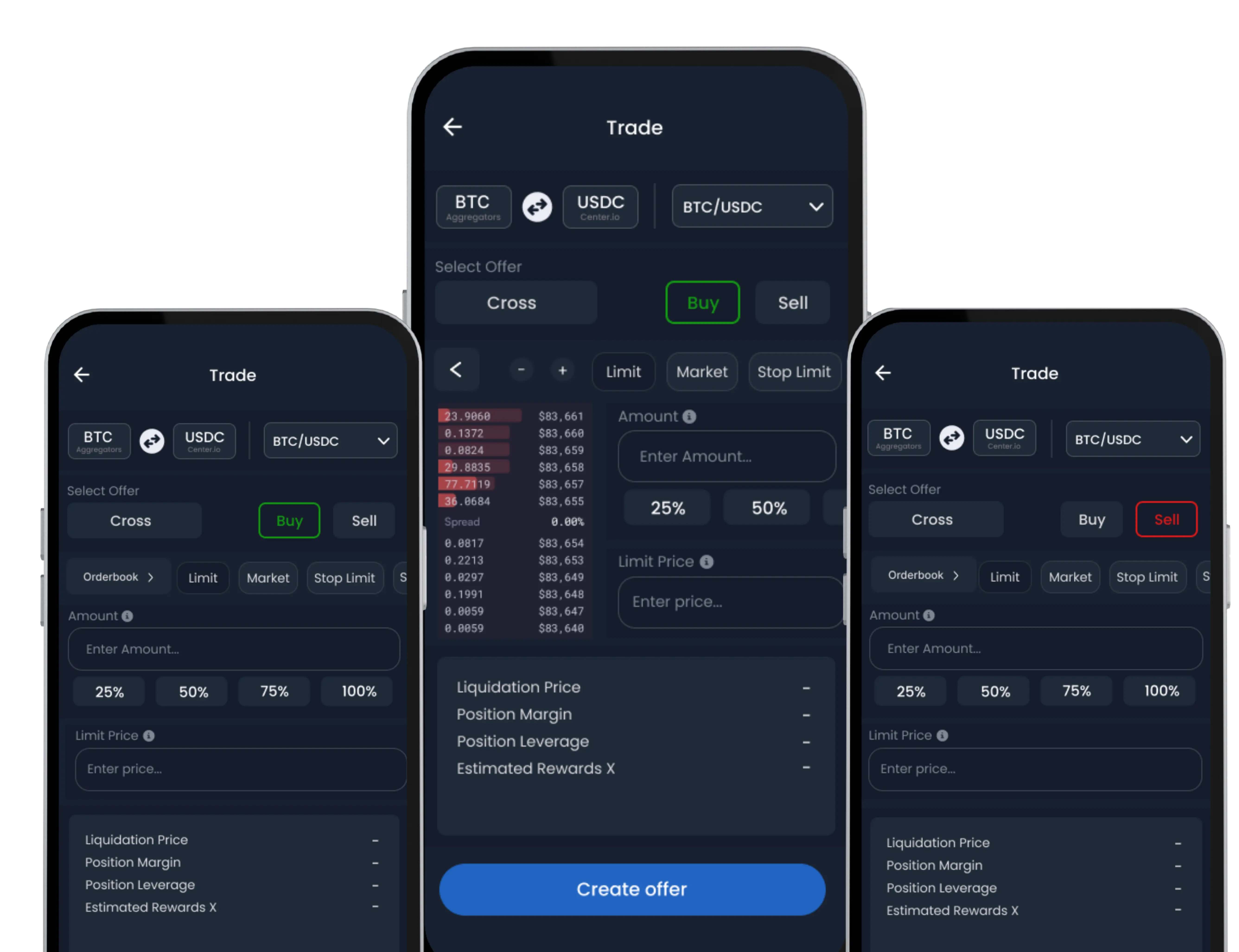
SwiftEx integrates with the Stellar network including native SDEX trading (spot and limit orders on Stellar-native assets) and, according to the SwiftEx team, Blend Protocol integration for deposit and borrow access from within the wallet interface. Users accessing Blend through SwiftEx benefit from the wallet handling footprint simulation and transaction construction, removing the need to interact with Soroban contract mechanics directly.
The underlying credit mechanics, isolated pool risk parameters, and Backstop Module behavior remain those of Blend Capital’s deployed contracts. SwiftEx surfaces those mechanics through its interface but does not add or modify the underlying protocol rules.
SwiftEx also supports multi-chain asset management across additional networks. Specific supported networks and cross-chain swap functionality should be verified against current documentation at swiftexchange.io, as supported chains and features evolve.
On-Chain Transaction Complexity
A practical benefit of wallet-level integration is that the interface can abstract Soroban’s transaction complexity from the end user. For example, the requirement to simulate transactions for footprint declaration and state restoration can be handled silently by the application layer, presenting the user with a simple confirmation step. This is an interface-level abstraction of the underlying Soroban mechanics , the protocol constraints still apply, but they are resolved before the user signs.
9. Frequently Asked Questions
What is the difference between Blend and DeFindex on Stellar?
Blend is a decentralized lending and borrowing protocol providing isolated credit markets with reactive interest rates and a first-loss backstop module. DeFindex is a yield-aggregation and vault infrastructure layer that allocates capital across multiple protocols, including Blend, through modular strategy contracts. Blend handles credit risk and liquidations. DeFindex handles portfolio allocation and user-facing accounting.
Who built DeFindex and Blend?
Blend was developed by Blend Capital. DeFindex was built by PaltaLabs. Both are independent teams contributing to the Stellar DeFi ecosystem, and both protocols are open source with contracts published on GitHub.
What is the role of the Backstop Module in Blend?
The Backstop Module is a mandatory first-loss capital layer required to activate any Blend lending pool. Depositors provide BLND:USDC 80:20 liquidity pool shares to underwrite bad debt risk. In exchange, backstop depositors receive a portion of borrower interest (the Backstop Take Rate) and BLND token emissions. If bad debt accumulates, the backstop absorbs the deficit before primary suppliers are affected. It is a bounded risk buffer, not an unconditional guarantee.
Are DeFindex vaults and Blend pools non-custodial?
Yes. Both are deployed on-chain protocols on the Stellar network. Neither Blend nor DeFindex holds user private keys , that is a property of the protocols themselves. Users retain exclusive control of their private keys through their own wallets. Vault share tokens representing deposited capital are held in the user’s own wallet and can be redeemed against the vault contract without any third-party authorization. Note that non-custody of keys by the protocol is distinct from the security properties of any wallet application used to access the protocol.
What is the BLND token?
BLND is the native governance and incentive token of the Blend Protocol. It is used to manage lending markets through the Backstop Module. Depositors who supply liquidity to lending pools or the backstop may receive BLND token distributions as a component of their yield. BLND is separate from XLM and is specific to the Blend ecosystem.
How does Soroban state management affect DeFi protocols?
Soroban requires all storage entries to have a valid TTL to remain accessible. Under Protocol 23, if entries become archived, they can be automatically restored during transaction execution (for Persistent and Instance entries), though restoration carries additional fees. Active protocols should implement proactive TTL maintenance as a cost and reliability optimization. Developers build this into keeper infrastructure to ensure users do not encounter unnecessary transaction failures.
10. Conclusion: A Composable Foundation for Stellar DeFi
Blend and DeFindex represent two distinct but complementary answers to a shared challenge: how do you build trustworthy, efficient decentralized financial infrastructure on a network designed for low-cost, fast settlement?
Blend answers by building isolated credit markets with a bad-debt protection layer, reactive interest rates, and Dutch auction liquidations. DeFindex answers by building a modular vault layer that routes capital into those markets automatically, managing rebalancing and accounting so that application developers and end users do not need to interact with protocol mechanics directly.
The interaction between these two protocols , and the broader Soroban constraint model that governs them both , represents a notable architectural foundation for Stellar DeFi as the ecosystem continues to develop through 2026. As more wallets, aggregators, and institutional applications integrate this stack, the depth and resilience of Stellar’s decentralized financial markets will depend on how well that architectural foundation holds under real-world load and market stress.
🔗 Official Protocol Links & Further Reading
Blend Capital
- Documentation: https://docs.blend.capital
- GitHub: https://github.com/blend-capital/blend-contracts-v2
DeFindex by PaltaLabs
- Documentation: https://defindex.io
- GitHub: https://github.com/paltalabs
Soroban & Stellar
- Soroban Developer Docs: https://developers.stellar.org/docs/smart-contracts
- Stellar Ecosystem Projects: https://stellar.org/ecosystem
Incident References
- YieldBlox oracle exploit: Halborn Security , “Explained: The YieldBlox Hack (February 2026)”
- DeFindex Beans case study: defindex.io/blog/beans-case-study
- DeFindex contract source (audited by OtterSec): github.com/defindex-io/stellar-contracts
- Blend liquidation mechanics: docs.blend.capital
- Soroban state model & Protocol 23: developers.stellar.org/docs/smart-contracts
SwiftEx
- Website: https://swiftexchange.io
- Community: https://t.me/swiftexchange
- Twitter / X: https://x.com/swiftex_wallet