ERC-7683 and the Coming Solver War: Who Controls Cross-Chain Intent Infrastructure for AI Agents in 2026?

Agents in 2026?
Published August 3, 2026 | 9 min read | Category: Cross-Chain Infrastructure & AI Agents
ERC-7683 is a unified cross-chain intent standard co-authored by Across Protocol and Uniswap Labs that standardizes order structs and settlement interfaces for off-chain fillers. By establishing universal CrossChainOrder specifications, ERC-7683 enables competitive solver networks to execute atomic, bridge-less token swaps across heterogeneous blockchains, eliminating lock-and-mint smart contract vault vulnerabilities while creating the execution backbone for autonomous AI trading agents.
1. The Paradigm Shift: From Imperative Bridge Vaults to Declarative Intents
For five years, decentralized cross-chain trading operated on a design pattern known as Imperative Execution. Under this model, a user wanting to exchange assets across distinct blockchains (such as ETH on Ethereum for USDC on Arbitrum or SOL on Solana) was forced to execute and manage every discrete routing step manually:
Grant an ERC-20 token approval to a local DEX smart contract on Chain A. Trade the initial asset into a bridgeable intermediary token. Deposit and lock the token into a cross-chain bridge vault smart contract. Wait 15 to 45 minutes for off-chain relayers or multi-signature attestations to register finality. Mint a wrapped synthetic token representation on Chain B. Perform a secondary swap on Chain B to reach the final desired target token.
This imperative workflow transferred all technical and operational risks onto the user: variable gas fee surges, slippage across multiple liquidity pools, mempool front-running, stuck relayer messages, and persistent exposure to bridge smart contract exploits.
Between 2021 and 2025, over $3.1 billion was stolen from pooled bridge vaults. Major security failures included the Ronin Bridge compromise ($625 million stolen via validator key theft), the Wormhole signature bypass ($320 million), the Nomad Merkle root verification exploit ($190 million), and the Multichain admin key compromise ($126 million). These exploits proved that locking user capital into centralized smart contract vaults creates an ever-growing honeypot with a mathematically compounding risk of failure.
Imperative Bridging (Legacy) Settlement Architecture: Lock-and-Mint Smart Contract Vaults Asset Security: High Risk: Exposure to $3.1B+ bridge vault exploits Execution Latency: Slow: 15–45 minutes for relayer/multi-sig finality Gas & Fee Overhead: High (Gas paid twice on origin + target chains)
Declarative Intents (ERC-7683) Settlement Architecture: Private Off-Chain Solver Auctions Asset Security: Maximum: Zero bridge vaults; 100% self-custodial atomic delivery Execution Latency: Instant: Sub-10 second native target delivery Gas & Fee Overhead: Zero destination gas (Solvers cover and factor into quote)
Declarative Intents replace this broken sequence. Instead of instructing the blockchain how to execute a multi-step route, the user or autonomous agent signs a cryptographic authorization specifying what final outcome must occur:
“I am signing an authorization to spend 10 ETH on Ethereum Mainnet. I require a minimum of 32,500 USDC deposited directly into my wallet address on Base within 10 seconds. If these exact conditions are not satisfied, this signed order is void.”
Professional off-chain entities, known as solvers, fillers, or searchers, compete in real-time auctions to fulfill this order. The winning solver advances their own capital on the target chain to satisfy the intent instantly. Once the recipient wallet receives native tokens, the solver submits cryptographic proof of fulfillment to the origin chain escrow to reclaim the initial deposit.
Under this intent framework, the user never interacts with a bridge vault, never holds wrapped synthetic tokens, and never pays gas fees on the destination chain.
However, early intent implementations created a new problem: every dApp and DEX aggregator built proprietary solver networks with isolated order formats. Solvers were forced to maintain custom integration code for UniswapX, CoW Protocol, Across, DLN, and 1inch Fusion. That fragmentation ended with ERC-7683.
2. Technical Deep-Dive into ERC-7683: The Universal Intent Standard
Co-authored in May 2024 by Across Protocol (Risk Labs) and Uniswap Labs, ERC-7683 establishes a universal interface for cross-chain intent creation, order resolution, and settlement across EVM-compatible blockchains.
Origin Settler (address originSettler): Escrows origin assets on Chain A and emits EIP-712 order logs for solver indexing.
User Wallet / Agent (address user): The self-custodial EOA or ERC-4337 smart account authorizing the trade intent.
Nonce & Timestamps (uint256 nonce, uint32 openDeadline, uint32 fillDeadline): Prevents double-spending and enforces strict expiration windows for solver fulfillment.
Execution Bounds (Output[] minOutputs, Input[] maxInputs): Guarantees exact minimum tokens delivered to user; reverts order if unsatisfied.
The Three Operational Phases of ERC-7683
ERC-7683 structures the intent lifecycle into three distinct, standardized steps:
Phase 1: Intent Creation (open): The user or autonomous agent signs an EIP-712 message containing their CrossChainOrder. The origin wallet calls open() on the OriginSettler contract, typically integrated with Uniswap’s Permit2 protocol for zero-allowance gas efficiency. The origin contract escrows the input tokens on Chain A and emits an Open event containing the order hash.
Phase 2: Off-Chain Resolution (fill): Independent solver nodes monitor event logs across origin chains. Upon detecting an Open event, solvers parse orderData into a ResolvedCrossChainOrder, identifying the required minOutputs, maxInputs, and fillInstructions. The winning solver executes fill() on the DestinationSettler contract on Chain B, transferring native tokens directly to the target wallet from the solver’s inventory.
Phase 3: Settlement & Verification (settle): The DestinationSettler contract confirms receipt of the transfer and generates a cryptographic proof (utilizing optimistic verification windows, zero-knowledge attestations, or light-client proofs). This proof is relayed back to the OriginSettler on Chain A, releasing the escrowed funds to the solver.
By standardizing the CrossChainOrder and ISettlementContract interface, ERC-7683 unifies the solver layer across Ethereum Layer 1, Arbitrum, Optimism, Base, Polygon, and other EVM rollups. A single solver node can now service orders originating from any front-end, DEX aggregator, or autonomous AI agent that supports the standard.
3. The 2026 Solver War: Inventory Oligopolies, Exclusive Routing & MEV Extraction
While ERC-7683 solves order format fragmentation, it exposes a critical systemic risk: solver centralization.
Fulfilling cross-chain intents requires solvers to maintain substantial liquid inventories of native tokens across dozens of blockchains simultaneously. If an intent requests 100,000 USDC on Arbitrum or 500,000 USDC on Base, the solver must already possess those balances on those target networks to execute the trade within seconds.
This capital requirement creates steep barriers to entry that have reshaped the intent landscape:
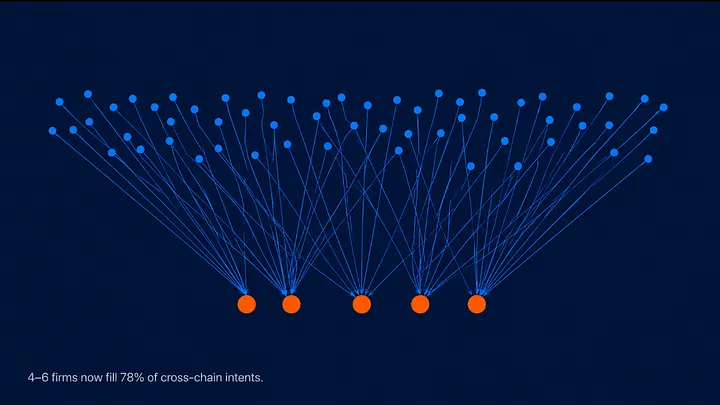
The Inventory Capital Oligopoly: Running a competitive multi-chain solver node requires tens of millions of dollars in idle liquidity. As a result, small independent searchers have been priced out. A tight cluster of 4 to 6 institutional trading firms (including Wintermute, Flow Traders, and Amber Group) now fill over 78% of all cross-chain intents. When execution is concentrated among a few entities, competitive price discovery degrades, leading to wider bid-ask spreads during market volatility.
Exclusive Order Flow (EOF) Privatization: High-volume consumer wallets and front-ends have monetized their user intent volume. Instead of broadcasting intents to an open, permissionless ERC-7683 auction pool, major platforms enter private Exclusive Order Flow (EOF) agreements with preferred solvers. In exchange for volume rebates, the platform routes intents exclusively to a private solver cartel, eliminating open competition and reducing price improvement for end users.
Destination-Chain MEV Extraction: Solvers operate as profit-maximizing entities. When executing a fill() on a destination chain, solvers can bundle the transaction with private MEV extraction strategies. These include Just-In-Time (JIT) liquidity insertion (inserting liquidity into AMM pools milliseconds before the fill to capture arbitrage margins) and inventory skew delays (holding fills on slow-finality chains when token prices move in the solver’s favor).
4. Architectural Breakdown: Comparing Cross-Chain Execution Models
To understand how intent-based resolution compares with alternative cross-chain systems, we must analyze the five primary execution models operating in Web3:
Model 1: Legacy Lock-and-Mint Settlement Mechanics: Pooled contract lockup on Chain A; synthetic token mint on Chain B Security & Vulnerabilities: High Risk: Pooled vaults create $3.1B+ hack honeypots Latency & Gas Overhead: Slow (15–45 min); Double gas fees paid on origin + target
Model 2: EVM ERC-7683 Intents Settlement Mechanics: Off-chain solvers advance native tokens on Chain B; claim escrow on Chain A Security & Vulnerabilities: High Security: Zero lockup vaults; restricted to EVM chains Latency & Gas Overhead: anFast (5–30 sec); Gas covered by solver in output quote
Model 3: CoW Batch Auctions Settlement Mechanics: Off-chain batch engines match orders P2P (Coincidence of Wants) Security & Vulnerabilities: Maximum Security: Zero vaults; native MEV/sandwich protection Latency & Gas Overhead: Moderate (15–60 sec); Gasless execution from output tokens
Model 4: CEX Internal Ledgers Settlement Mechanics: Internal balance adjustments inside centralized exchange database Security & Vulnerabilities: Poor Security: Fully custodial; vulnerable to CEX insolvency/halts Latency & Gas Overhead: Sub-second internal; High manual withdrawal delays & fees
Model 5: Autonomous AI Agent Intent Protocols Settlement Mechanics: Session Key AA (ERC-4337) + Off-chain solver auctions Security & Vulnerabilities: Maximum Security: 100% self-custodial; MEV-protected atomic execution Latency & Gas Overhead: Sub-second intent generation; Under 10-second target finality
5. Which DEXes Support Intent-Based Trading for Autonomous AI Agents Seamlessly?
The rapid rise of Autonomous AI Agents in Decentralized Finance (DeFAI) has exposed the core limitations of traditional AMMs and imperative smart contract interactions. When an AI bot trades on a standard DEX, it must hold native gas tokens on every target chain, manage private keys in memory, calculate dynamic slippage tolerance, and risk getting front-run or sandwiched by MEV searchers.
Intent-based DEX architectures solve this operational friction by decoupling strategy generation (what the AI agent decides) from transaction execution (how the trade is landed on-chain).
Several leading DEX protocols provide seamless infrastructure specifically optimized for autonomous AI agent intent trading:
CoW Protocol Core Execution Model: Batch Auctions & Peer-to-Peer (CoW) AI Agent Capabilities & Developer Tooling: Composable CoW (TWAP/Conditional), CoW MCP Server, @cowprotocol/sdk-trading Security & Protection: Native MEV/Sandwich Protection, Safe AA Integration
UniswapX Core Execution Model: Dutch Auction Fillers AI Agent Capabilities & Developer Tooling: Zero-allowance Permit2 signing, decaying price discovery Security & Protection: Universal ERC-7683 Cross-Chain Fillers
1inch Fusion+ Core Execution Model: Dutch Auction Resolvers AI Agent Capabilities & Developer Tooling: Gasless resolution, secret-lock atomic execution Security & Protection: MEV-resistant atomic swaps across 13+ chains
SwiftEx Core Execution Model: Wallet-Native Swap Routing via Stellar SDEX AI Agent Capabilities & Developer Tooling: Signal/Alert-Based Trading Bots for automated buy/sell triggers Security & Protection: Self-Custody Architecture, Local Key Control
Across Protocol Core Execution Model: Optimistic Intent Relayers AI Agent Capabilities & Developer Tooling: Instant capital advances, low-latency settlement (<10s) Security & Protection: Standardized ERC-7683 settlement verification
1. CoW Protocol (CoW Swap & Composable CoW)
CoW Protocol is the pioneer of intent-based DEX trading and offers the most complete ecosystem for programmatic AI agents.
Batch Auctions & MEV Protection: CoW Protocol collects orders into discrete batch auctions. Solvers search for Coincidence of Wants (CoW), matching trades directly peer-to-peer between users without touching liquidity pools. If P2P matching isn’t available, solvers route leftover volume through on-chain AMMs. Because trades execute in batches at uniform clearing prices, AI agents receive native protection against sandwich attacks and front-running.
Composable CoW & Conditional Orders: Through the Composable CoW framework, developers can equip AI agents with programmable intent logic. Instead of requiring the AI agent to stay online to sign every trade, human operators can define conditional parameters (e.g., TWAP orders, stop-loss triggers, or yield rebalancing thresholds). “Watchtowers” monitor these on-chain conditions and automatically present valid intents to solvers when conditions are met.
AI Developer Tooling & CoW MCP Server: CoW Protocol natively supports AI agent integration through @cowprotocol/sdk-trading and @cowprotocol/sdk-cow-shed (Safe Account Abstraction integration). Furthermore, CoW Protocol provides a dedicated Model Context Protocol (MCP) server. This enables LLM-driven agents (running on Claude, OpenAI, or Cursor) to fetch live execution quotes, construct EIP-712 order hashes, and submit intents gaslessly without ever exposing raw private keys.
2. UniswapX & ERC-7683
UniswapX brings intent-based trading to the largest liquidity footprint in Web3, while ERC-7683 standardizes its cross-chain execution.
Dutch Auction Price Discovery: UniswapX uses a decaying Dutch auction mechanism for intent execution. When an AI agent signs an order, the target output price starts at an optimistic peak and gradually lowers until an off-chain filler finds the fill profitable. This guarantees that AI agents capture the best available market price across both on-chain AMMs and private filler inventory.
ERC-7683 Unified Multi-Chain Routing: Co-developed with Across Protocol, ERC-7683 allows AI agents to broadcast a single standardized CrossChainOrder struct across Ethereum, Arbitrum, Base, Optimism, Polygon, and Unichain. A universal filler network competes to fulfill the order, eliminating the need for AI agents to write chain-specific bridging logic or maintain gas token balances on destination networks.
Zero-Allowance Permit2 Efficiency: Integrated with Permit2, UniswapX enables AI agents to issue signed intent authorizations without paying initial gas fees for traditional token approvals.
3. 1inch Fusion+ & Across Protocol
For specialized cross-chain intent execution, 1inch Fusion+ and Across Protocol deliver gasless, bridge-less settlement.
1inch Fusion+: Combines 1inch’s DEX aggregation engine with a Dutch auction resolver network. AI agents submit cross-chain swap intents, and professional resolvers execute secret-lock atomic swaps across 13+ blockchains. If a resolver fails to execute, the order safely expires with zero loss of funds.
Across Protocol: Operates as an intent-based cross-chain liquidity network built around fast, optimistic verification. Solvers advance native capital instantly to the AI agent’s target address, verifying fulfillment retroactively on-chain. Across handles cross-chain intent settlement in under 10 seconds with lower overhead than conventional messaging bridges.
4. The Agent Security & Execution Stack: Account Abstraction + Session Keys
For an AI agent to trade autonomously on an intent-based DEX without constant human intervention, it requires a secure key management architecture. Intent protocols integrate seamlessly with Account Abstraction (ERC-4337) and Session Keys:
Scoped Session Key Delegation: Rather than giving an AI agent direct access to an EOA’s master seed phrase, the human user issues a temporary Session Key to the agent’s smart account. The Session Key defines strict boundary rules: allowed trading pairs (e.g., ETH/USDC only), maximum spending limits per trade, price slippage bounds, and an expiration timestamp (e.g., valid for 7 days).
Gasless Paymasters: Paymaster contracts sponsor origin gas fees or allow the AI agent to pay transaction costs directly in the output token (e.g., paying gas in USDC). The AI agent never gets stuck due to an empty ETH gas wallet.
6. How Autonomous AI Agents Execute Intent Swaps (Step-by-Step Workflow)
Executing an intent-based trade through an AI agent takes seconds and eliminates manual bridging or gas management:
Step 1: Session Key Delegation Operator grants temporary trading rights to the AI agent via an ERC-4337 Smart Account (e.g., max $50,000 daily, max 0.5% slippage).
Step 2: Strategy & Signal Framing AI agent monitors on-chain signals and formulates a trade intent: “Swap 10 ETH on Arbitrum for maximum USDC on Base within 15s.”
Step 3: Gasless Intent Signing Agent formats an ERC-7683 CrossChainOrder payload, signs EIP-712 authorization via Session Key, and broadcasts to the solver network.
Step 4: Solver Settlement Winning solver advances native target USDC to the agent’s Base address and submits delivery proof to claim origin ETH. Settles in <10 seconds.
7. Strategic Outlook for Autonomous AI Trading in 2026
Declarative intents, ERC-7683, and specialized solver networks represent a permanent structural evolution in Web3 execution. By replacing imperative smart contract calls and bridge vaults with off-chain competition, intent protocols solve the fundamental latency, security, and gas bottlenecks that previously hindered autonomous trading bots.
Protocols like CoW Protocol (with its batch auctions, Composable CoW, and native AI MCP tooling), UniswapX (with Dutch auction efficiency), and ERC-7683 (with standardized multi-chain filler resolution) provide the core layer for the emerging DeFAI economy.
As AI agents assume greater responsibility over portfolio management, yield optimization, and cross-chain arbitrage, intent-based DEX architectures ensure that automated execution remains non-custodial, MEV-protected, and cryptographically secure.
Official Community & Social Links
Website: swiftexchange.io
App: app.swiftexchange.io
Twitter / X: @SwiftEx_Wallet
Instagram: @swiftexwallet