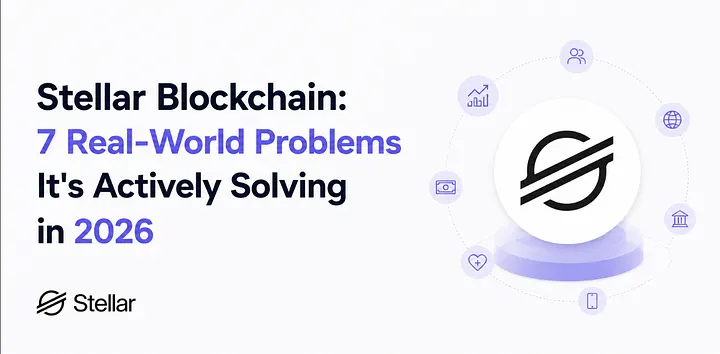
DTCStellar Blockchain: 7 Real-World Problems It’s Actively Solving in 2026
Introduction:
$600 billion moves across borders every year as remittances. A large slice of it disappears in fees.
Wire transfers still take days. Banks turn away 1.4 billion adults globally. The infrastructure built to move money has barely changed in three decades.
Stellar is changing that. No roadmap promises. Live deployments. As of mid-2026, the network hosts over $2 billion in real-world assets, processes $500 million in USDC monthly, and just secured a partnership with DTCC, the clearinghouse that settles $114 trillion in US securities. Transactions settle in 3–5 seconds. Fees stay under a cent.
This post breaks down the specific problems Stellar solves, the real 2026 numbers behind those solutions, and why institutional adoption accelerated faster this year than in any previous one.
Here’s what you’ll learn:
- How Stellar’s payment infrastructure handles cross-border volume in 2026
- Why MoneyGram extended its Stellar partnership across Latin America
- How DTCC’s tokenization of US stocks, ETFs, and Treasuries lands on Stellar
- What the Protocol 25 X-Ray upgrade means for institutional privacy
- How Societe Generale and Zebec are deploying stablecoins on Stellar
- Why SushiSwap chose Stellar for its 2026 DeFi expansion
- How Stellar’s PayFi initiative is opening credit and trade finance on-chain
1. Cross-Border Payments: Native Infrastructure at Scale
Banks charge 3–6% on international wire transfers. SWIFT takes 1–5 business days. A business moving $100,000 abroad loses up to $6,000 in fees, plus the cost of waiting.
Stellar settles transactions in 3–5 seconds. The fee is 0.00001 XLM, fractions of a cent. The network handles 1,000+ transactions per second with no congestion pricing.
In April 2026, Wirex and Ultra Stellar launched native payment infrastructure built directly on Soroban, Stellar’s smart contract platform. The integration connects Wirex’s 7 million global users and Visa/banking rail access with Ultra Stellar’s LOBSTR and StellarX products. Developers building on this layer can embed bank accounts, card issuance, cross-border payouts, and yield products natively on-chain. No external middleware required.
This infrastructure went live in April 2026. It runs today.
2. Remittances: MoneyGram’s Latin America Expansion
The Philippines receives $36 billion in remittances annually. Nigeria gets $20 billion. El Salvador, Colombia, and most of Central America depend on remittance flows that historically lose 5–8% in transfer fees.
Stellar’s remittance architecture runs through anchor institutions: licensed local operators holding fiat reserves on both ends of a corridor. A sender deposits US dollars. The anchor on the receiving end releases local currency within seconds, settling the transfer over Stellar’s network. No correspondent bank required.
At Stellar House Mexico City in April 2026, MoneyGram and the SDF announced a multi-year partnership extension, five years after their original integration. The new phase expands stablecoin utility across Latin America. The MoneyGram app with an in-app stablecoin balance is live in Colombia and extended to El Salvador, with additional Central and South American markets launching through the rest of 2026.
Five years. Active corridors. Real money reaching real recipients daily.
3. Financial Inclusion: Reaching the Unbanked
1.4 billion adults worldwide have no bank account. Most live across sub-Saharan Africa, South Asia, and Southeast Asia.
Banks won’t serve them. No credit history, no fixed address, no minimum balance. Mobile money networks exist but don’t connect to global financial infrastructure.
Stellar treats this as a plumbing problem with a technical fix. The network runs low-cost mobile wallets on a basic smartphone, no bank account required. The minimum account balance is 1 XLM, which sits under $0.20 at most price points.
Franklin Templeton’s BENJI money market fund runs on Stellar, giving retail users mobile access to US Treasury-backed yields without a brokerage account. The SDF’s Stellar Disbursement Platform has distributed humanitarian aid in active conflict zones, routing USDC directly to recipients who have no bank access at all.
The SDF’s 2026 strategy targets onboarding 15 new transformational enterprises, including Forbes Global 2000 companies, international NGOs, and government agencies, with at least 5 deploying live products this year. Most of those deployments are aimed at markets traditional finance has never served.
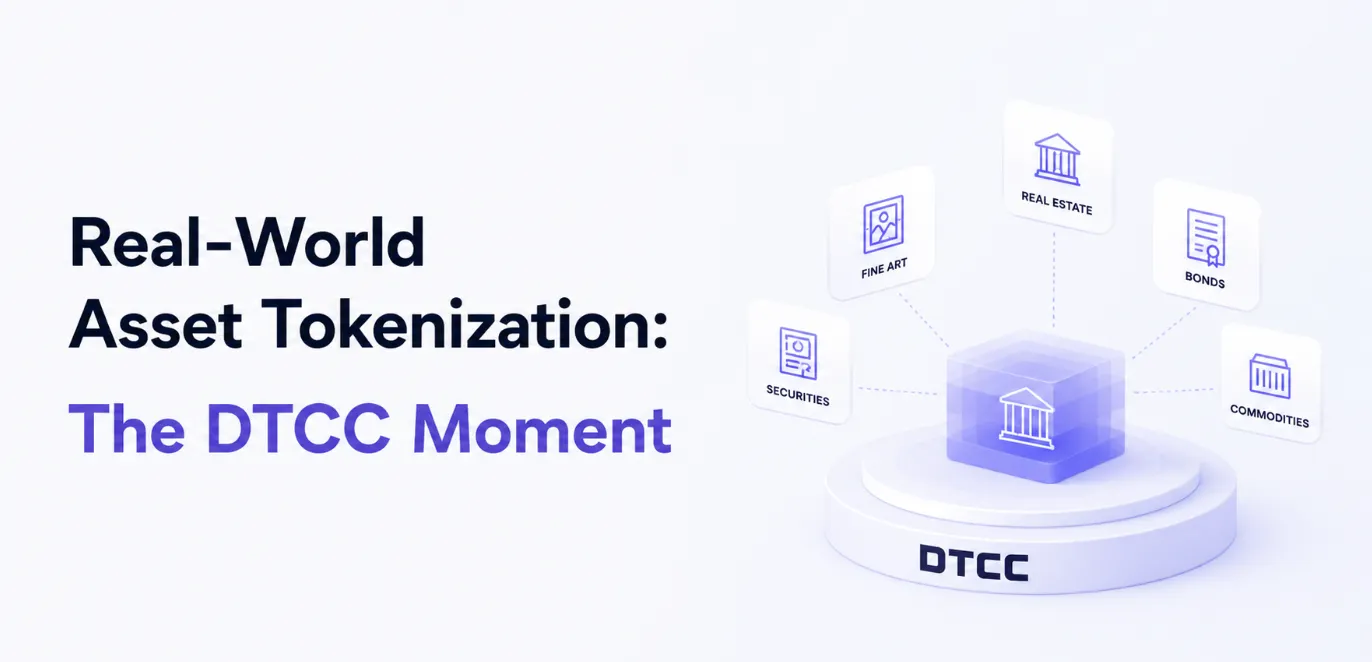
4. Real-World Asset Tokenization: The DTCC Moment
Tokenization puts ownership of real assets on a blockchain: stocks, bonds, real estate, treasuries. It makes fractional ownership possible and settlement instant.
Stellar’s RWA market cap (excluding stablecoins) grew 91% quarter-over-quarter in Q1 2026, from $796 million to $1.52 billion. It crossed $2 billion on April 11, 2026. RWA transfer volume on Stellar grew 164% in a 30-day window as of February 2026, according to Scopuly data.
Then came the DTCC announcement.
On May 27, 2026, DTCC, the clearinghouse for $114 trillion in US assets, announced plans to connect its tokenized securities platform to Stellar. DTC-custodied assets, including Russell 1000 stocks, major index ETFs, and US Treasuries, are expected to go live on Stellar in the first half of 2027. Limited production tokenized trades begin July 2026, ahead of a broader October 2026 service launch.
The SEC’s December 2025 no-action letter made this legally possible. DTCC’s Depository Trust Company retains the authoritative legal record. Stellar hosts a synchronized on-chain representation of the same asset. This is the first time DTC-custodied securities will live on a public blockchain.
Franklin Templeton’s BENJI fund, T. Rowe Price’s ETF tokenization work, and Etherfuse’s launch of Korean government bonds (KTB) on Stellar in January 2026 all pointed the same direction. DTCC confirmed it.
5. Stablecoins: The Dollar and Now the Euro, for Every Market
People in high-inflation economies need dollar-denominated assets. Most can’t access them through a bank. Stablecoins fill that gap directly, and Stellar is one of the largest active networks for them.
USDC on Stellar processes $500 million monthly. Circle chose Stellar for USDC deployment because of its settlement speed, compliance-friendly design, and low fees. Every USDC transaction on Stellar settles in under 5 seconds at sub-cent cost.
In 2026, stablecoin activity on Stellar expanded past the dollar. Societe Generale-FORGE, the crypto division of one of Europe’s largest banks, deployed its EUR CoinVertible (EURCV) on Stellar. EURCV is MiCA-compliant, making it the first major regulatory-compliant euro stablecoin running on Stellar’s network.
Bitget Wallet integrated Stellar’s payment infrastructure in March 2026, expanding stablecoin-based cross-border payment access to its global user base. Zebec brought its payment streaming infrastructure to Stellar in 2026. It was Zebec’s first deployment outside the Solana blockchain, enabling real-time payroll, subscriptions, and disbursement flows.
In Argentina, Venezuela, and Nigeria, users are actively converting into USDC via Stellar to protect purchasing power against inflation. This is organic adoption driven by economic pressure. Nobody is marketing it. It’s happening regardless.
6. Privacy Infrastructure: Protocol 25 and the X-Ray Upgrade
Institutional finance has one requirement most public blockchains can’t meet: confidentiality.
Banks cannot put sensitive transaction data on a fully transparent public ledger. Compliance frameworks under MiCA, MAS, and FINRA require auditability, not public exposure of counterparty details, position sizes, or transaction flows. Those are two different things, and most blockchains treat them as the same.
In January 2026, Stellar launched Protocol 25, named X-Ray, on mainnet. The upgrade brings native zero-knowledge proof primitives, specifically BN254 elliptic curve operations and Poseidon hash functions, at the protocol level. Developers can now verify ZK proofs on-chain without writing custom cryptography inside smart contracts.
Financial institutions can settle on Stellar without broadcasting sensitive data to every node on the network, while still giving regulators the audit trail they require.
Protocol 26 (“Yardstick”) followed in May 2026. Each upgrade adds capabilities that previous blockchain generations were never architected to handle.
Privacy was the most common objection institutions raised about using a public blockchain. X-Ray addressed it at the protocol level.
7. DeFi on Stellar: SushiSwap, Oracles, and PayFi
The criticism of Stellar used to be valid: no smart contracts, limited DeFi, mostly a payments rail.
Soroban changed that. Since launching on mainnet in 2024, Soroban has driven a 7x increase in on-chain activity. In 2026, DeFi activity on Stellar moved from early testing into active production.
SushiSwap’s V3 AMM launched on Stellar on February 10, 2026. SushiSwap is one of the most established DEX protocols in DeFi, and it chose Stellar for its expansion. Redstone Oracle went live in March 2026 with 17 price feeds covering BTC, ETH, USDC, PYUSD, and BENJI, extending Stellar’s earlier integration into Chainlink’s Scale Program. Rails launched institutional-grade USDC collateral vaults on February 3, 2026, for hybrid perpetual futures trading.
The SDF’s PayFi initiative takes this further. PayFi, short for Payment Financing, brings credit, trade finance, and working capital tools on-chain through stablecoins and Stellar’s payment infrastructure. The G20 has set a 2027 target for 75% of international payments to settle within one hour at under one cent. Stellar’s PayFi build targets that benchmark directly.
CME Group launched Stellar futures in February 2026, trading at over $150 million per day. Regulated institutional trading on Stellar exposure is now live on one of the world’s largest derivatives exchanges
.
Stellar runs payments, settlement, DeFi, and institutional asset management from a single network.
Conclusion
In 2026, Stellar is running DTCC’s tokenization pathway for US securities. Processing MoneyGram transfers across Latin America. Hosting $2 billion in real-world assets and $500 million in monthly stablecoin volume. Powering the first MiCA-compliant euro stablecoin from a major European bank.
X-Ray solved the privacy problem institutions cited most. Soroban filled the smart contract gap critics pointed to for years. DTCC’s involvement settled the institutional credibility question.
Payments, remittances, asset tokenization, stablecoins, CBDCs, DeFi, privacy: each one has a live Stellar deployment behind it right now.
Stellar stopped making the case for adoption. The deployments are making it instead.
Follow SwiftEx on: